The Day the Harness Team Realized They Were Working Themselves Out of a Job
One year after the 2 AM page, the pager is quiet. The reconciliation agent has successfully cleared every invoice for two hundred straight nights. The team's current dashboard is not the incident board. It is the eval suite.
And here is the detail worth sitting with: half the harness they built in that first urgent quarter has been deleted, absorbed by newer models. The team is faster than it has ever been. Both of those facts are one and the same.
Every pattern in this series has a shelf life. That is not a bug. It is the engine.
Seven episodes in, we've walked the anatomy of a production harness. We've named six paradoxes, priced the program, shipped a Monday morning kit, and watched organizations rebuild themselves around the concept.
A reader who's been with me the whole way now possesses a roadmap. And if the last eighteen months are any guide, half of that roadmap will be wrong inside of two years.
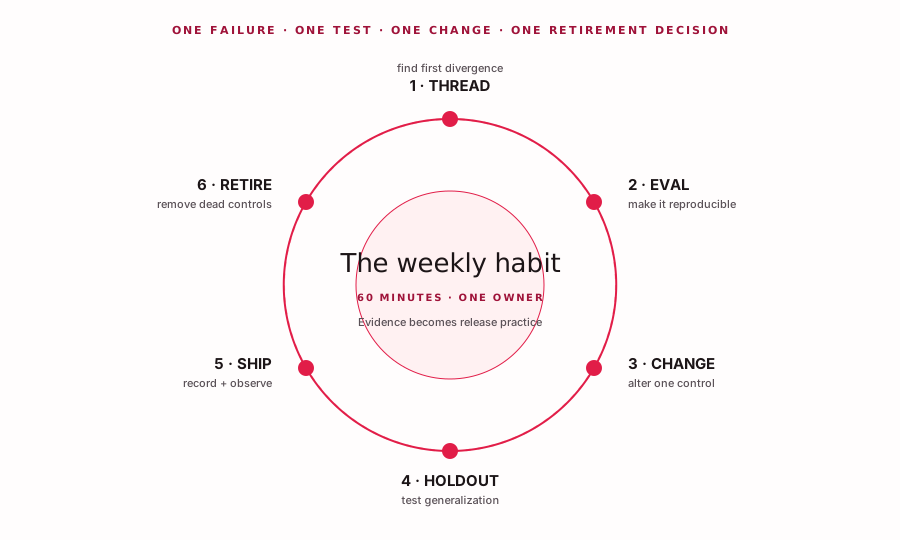
That is not a reason to stop. That is the reason the discipline exists. The harness that gets worse every year is one that was written down once and left *it* there. The harness that gets better every year has a feedback flywheel. Production traces feed new evals. Evals diagnose targeted harness edits. Edits get validated on holdout sets. The whole loop runs on a cadence nobody has to remind you about.
The discipline makes itself unnecessary in any single component by continuously replacing those that no longer pay their way.
Put the user outside the stack one last time. Every trace that mines into a new eval, every edit that tightens a prompt, every retired component that folded into the model, all of it is motion inside the system.
The person asking for the work remains static. They just notice that the agent gets steadier quarter after quarter for reasons they never see.
So this finale is the operating manual for that flywheel. If the frontier models keep absorbing harness capabilities, what's the mechanism that keeps your harness compounding? The answer lies in the Observability & Evals cluster from Episode 2, Inside a Production Agent Harness, finally opened.
The idea in one boxCapabilities migrate into the model. The jobs they were doing do not disappear. Five residents never leave the harness: your evals, your workflows, your audit trail, your cost controls, your users' context. The flywheel running across those five is the moat. Patterns expire. Instincts compound.
- 01. The five capabilities that have migrated from harness to model in the last 24 months, and what was lost in the trade.
- 02. The five permanent residents of the harness, the work that will never cross the line into the model, now with the sharpest external validation the thesis has received.
- 03. The feedback flywheel as mechanism, not metaphor, the four-phase loop that turns a harness into something that compounds, and the published proof that it works (a coding agent moved rank 30 → top 5 with no model change).
- 04. Four verbatim harness-edit examples from the LangChain practice, each traceable to a cluster on the Episode 2 map.
- 05. A four-question framework for predicting which of today's patterns will dissolve by 2027, which will compound, and which have entered the self-improving tier where the harness tends itself.
- 06. The next horizon, evals that are themselves agents, and harnesses that design entire agent organizations.
- 07. Why the discipline itself is transferable, the four instincts harness engineering installs that apply everywhere stochastic meets contract.
What the Model Has Already Absorbed From the Harness
Let me show you the moving picture first, because it's easier to accept what's happening when you see the pattern in the rearview mirror rather than the windshield.
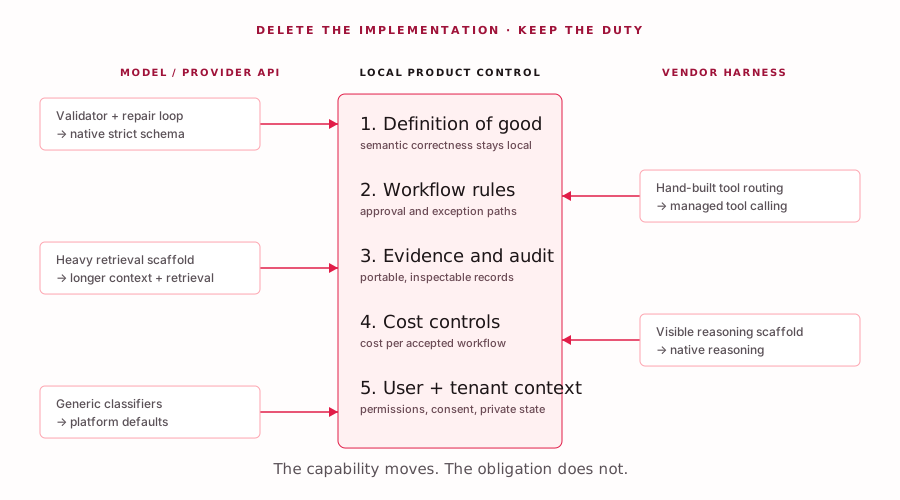
Five categories of capability that used to require serious harness engineering now arrive native in most frontier models. Each one represents months of engineering effort that no longer earns its keep in a new project.
Each one also took something with it. The second part matters more than the first.
Harness version: A JSON validator loop. Model returns a broken brace, validator catches it, harness re-prompts with the error, repeat until valid. Elaborate retry ladders with temperature stepping, few-shot re-grounding, grammar-constrained decoding on top.
Model version: Native strict mode. You declare the schema, the model emits insideThe validator loop served as a quiet sanity check on semantic drift; sometimes the JSON parsed, but the values were wrong.lues were wrong. Teams that relied heavily on the validator forgot to build the underlying semantic check. When the loop went away, some discovered their real eval coverage was thinner than they thought.
Harness version: The ReAct loop. Reason, act, observe, repeat. Hundreds of lines of orchestration with tool parsing, trace stitching, and the whole loop sitting outside the model.
Model version: Native tool use. Register the tools, the model picks them, invokes them, reads the results, and continues.
Harness version: Chunking-plus-retrieval RAG pipelines, the signature architecture of 2023. You built RAG because the model couldn't read your document.
Model version: Two hundred thousand tokens of native context, and serious models edging past a million.
What was lost. RAG was never solely about context length. It was also about freshness, governance, and cost control. Your retrieval layer was where you decided which sources were approved, current, or rate-limited. Teams that collapsed the entire pipeline into "just paste the documents" lost the governance capability. The retrieval was optional. The policy it enforced was not.
Harness version: The scratchpad. Prompt the model to think step by step, log the intermediate reasoning, use that trace as a structural spine for tool selection and verification.
Model version: Native chain-of-thought, often invisible, often more rigorous than your scaffold was.
Harness version: Custom guardrail layers were used for prompt-injection detection, PII redaction, jailbreak patterns, toxicity classification, and output-policy enforcement.
Model version: A larger share of those responsibilities sits inside the model's training and safety layer. The frontier has absorbed the common cases.
What was lost: Native safety is tuned to a general distribution of risks, not your domain's specific ones. Healthcare continues to need HIPAA redaction. Legal continues to need privilege-preserving guardrails. A kids' product still requires its own content policy. The generic layer moves the floor up. It does not remove the need for domain-specific policy.
One can draw a line under these five and see the pattern. Each capability was generic enough, scale-sensitive enough, and inside the labs' economic self-interest to absorb. Each one now appears as a native feature. Each one also dragged a quieter capability out with it: explainability, governance, domain specificity. Teams had to rebuild those somewhere else.
And I should be honest about the speed of the ladder, because the May 2026 research forced me to update my own estimate. Some sophisticated reasoning scaffolds are dissolving faster than the five-item list suggests, work on internalizing heavy-thinking and parallel-deliberation patterns directly into models has shown large benchmark lifts that generalize across model backbones.
The dissolving ladder is not a fixed menu. It is a live boundary that moves whenever a lab finds economic incentive to absorb more of the harness's work.
Anthropic supplied the cleanest specimen of the timer from inside their own lab, Episode 4 tells it in full, and one line of it belongs here. A context-reset mechanism their harness team built for one model generation's context anxiety was simply unnecessary one generation later. “The resets had become dead weight.” Their best harness fix expired in a single model cycle, and they published the obituary themselves.
But the same post reveals what the five-item list does not capture. The ladder now dissolves in two directions at once. Capabilities migrate up into the model. That is the list above. Infrastructure migrates down into managed platforms. Managed Agents, Anthropic's hosted meta-harness, absorbs the durable sessions, the sandboxes, and the loop, while explicitly leaving the judgment outside.
What neither direction touches is the middle: your evals, your policies, your workflows, your definition of done. The squeeze on that middle is the clearest map of the moat anyone has drawn. The labs drew it for you.
June 2026 revealed a middle rung nobody had named. Capabilities do not only migrate from your harness into the model. Sometimes they migrate into the vendor's harness. That is a different trade entirely.
Parallel task decomposition is the clean specimen. It did not become a Messages API parameter. It became dynamic workflows inside Claude Code, plan-gated, capped at roughly a thousand subagents, enterprise-tier. You stopped needing to build fan-out logic. But the replacement is not the model does it. The replacement is Anthropic's harness does it, on Anthropic's terms, inside Anthropic's product. (LangChain's dynamic subagents, shipped July 1, is the open-source counterweight, same capability, your harness.)
Name the two destinations, because they price differently.
A clean win. You delete code and keep your architecture. The capability crosses into weights; your product surface is unchanged.
A trade. You shed engineering cost and take on vendor coupling in the same motion. The capability crosses into someone else's product surface, on their pricing, on their availability, on their roadmap.
The dissolve test at the end of this episode should say, for every dissolving capability, which destination it is headed for. One is a gift. The other is a lease.
The capability migrates. The job it was doing does not.
The Dissolving LadderThis is the texture of the dissolving ladder. Not “your work was wasted”, the harness did its job and then the floor caught up. The real story is that the capabilities the labs found generic enough to absorb took the visible work, and left behind the quieter residue that your product still needs.
Finding where that residue lives, and putting it somewhere permanent, is what separates a team that gets obsoleted by each model release from a team that compounds across them.
What Stays in the Harness, No Matter How Smart Models Get
The opposite list matters more. There are capabilities that cannot cross the line into the model, not because the labs haven't tried, but because the structure of the problem does not permit it. These are the permanent residents of the harness, and the more clearly you can name them, the more confident you can be about what you are actually investing in.
Five categories. Each one is not a model problem and will never become a model problem, because it depends on information, incentives, or obligations the model structurally cannot have.
Your product's definition of “good” is not the model's job. A support agent that answers correctly but in a tone the brand team would reject has failed your eval even if it would pass the model's. The frontier labs can give you general helpfulness. They cannot give you your product's opinion about what counts as a good answer on a Tuesday. That opinion is yours to hold, to version, to evolve. The moment you outsource it, you don't have a product anymore. You have a wrapper.
The model doesn't know your approval hierarchy. It doesn't know refunds over fifty dollars need a manager signoff, that contracts over ten thousand need legal review, that your ERP talks to your CRM through a bridge written in 2017 by someone who left. Every enterprise harness lives on information specific to your organization in a way no training corpus can represent. The harness is where this information becomes enforceable.
A model is a stateless transformation. Your organization is a stateful record. Regulatory, legal, and compliance obligations outlive any individual model by an order of magnitude. Your audit log needs to say who did what, when, why, with what authorization, and what happened next. Tamper-evident, queryable, exportable, legally defensible. The evidence has to live in a system you control and can testify about in court. The harness is that system.
The model will always burn more tokens than your CFO wants. This is not a bug in the economics of AI. It is the economics of AI. Your harness is where per-user budgets, per-workflow budgets, per-tenant budgets, and hard circuit breakers live. It is where spend spikes get caught before they become quarterly explanations. (Episode 5 carries the fleet-scale example, one reported agent fleet burned through 603 billion tokens and over a million dollars in a month. The magnitude is the point.) A frontier model will not police this for you, because spending more is its revenue. The harness is adversarial to the model on cost, and that's correct.
Privacy-sensitive, per-user state cannot live in a general model. Your user's preferences. Their history. Their consent records. Their tier, their locale, their accessibility settings. Information the model should never carry across users, and increasingly cannot carry legally. The harness is where this state gets assembled per request, injected with the right scoping, and redacted on the way out. A model that tries to absorb this crosses privacy lines no enterprise can tolerate. So it won't. The work stays with you.
Name these five residents in your own harness today. Write them in a document. Put the document in front of your engineering lead. Every investment you make on top of these five compounds, because the floor under them does not rise.
Every investment you make in a capability not on this list has a timer on it, and you should know what the timer reads before you sign off on the sprint.
I spent two years arriving at this list by watching programs succeed and fail. Then, in 2026, the most credible infrastructure voice of his generation compressed it into three lines. Mitchell Hashimoto built Terraform.
He has watched more infrastructure layers commoditize than almost anyone alive. Here is his verdict:
Mitchell Hashimoto · February 2026“Models are now commodities. Harness is the moat: business rules, data pipelines, verification logic, none of this transfers when you swap models.” ↗
Read the five residents against that sentence. Business rules: org-specific workflows. Data pipelines: user-specific context, observability. Verification logic: domain-specific evals. The permanent residents are not a conservative list I built to hedge. They are the parts of the system whose value is definitionally local to your organization and your users. Everything else has a timer.
The moat has a name now, and it is not the model.
In a single month, two of the five residents got sharper. A sixth candidate applied for residency.
On June 3, OpenAI announced it is retiring its hosted Agent Builder and Evals products, effective November 30, 2026. There is the argument in one sentence: labs churn products; your definition of good cannot live on someone else's roadmap. Every team that authored ground truth inside that shelf now migrates on a deadline it did not choose.
In June, Anthropic announced, and then paused, on June 15, the metering of programmatic agent usage at API rates. The date moved. The direction did not. The meter is coming, and the harness stays adversarial to the model on spend. Correctly. Forever.
On June 12, a US export-control directive suspended Fable 5 for every customer on Earth, three days after launch, zero notice, nineteen days dark. Add to that the scheduled kind of darkness: the original Opus 4 and Sonnet 4 identifiers retired the same June 15, erroring every pinned production call.
The routing policy, the capability-degradation map, and the fallback evals that let your product survive a dark model are not scaffolding. No model absorbs that bundle. It exists precisely for the day the model is gone. Nineteen days made it a budget line, not a thought experiment.
The Feedback Loop, Opened
Here is the mechanism that keeps the five permanent residents from calcifying into dead weight. I call it the feedback loop because the mechanics are what matter and the name matters less. It is a four-phase cycle that runs through the Observability & Evals cluster from Episode 2, and every mature harness I have seen in production is running some version of it.
Phase one, Data sourcing. Evals come from three places: hand-written cases that encode your product's definition of good; production traces that got labeled; and external datasets when you can find ones that match your workflow shape. “Every trace contains valuable data to produce a potential eval. And every (good) eval makes the harness better.” (Vivek Trivedy, LangChain, Better Harness, April 2026).
The discipline involves continuous mining of production traces, not just at launch.
Phase two, Experiment design. Every eval set is split into an optimization set and a holdout set. The optimization set is what you design against; the holdout set is what you validate against. “Holdout sets become a proxy for true generalization.” Without the split, you are overfitting your harness to pass its own tests, and agents are “famous cheaters: Any learning system is prone to reward hacking where the agent overfits its structure to make the existing evals pass.” The split is not optional. The split is what keeps the loop honest.
Phase three, Optimization. Diagnose, experiment, validate. Read the optimization-set failures. Propose a concrete harness edit, a prompt change, a schema tighten, a tool rename, a middleware hook. Run the proposed edit against the optimization set.
If it improves performance, advance. If it does not, diagnose again. This cadence is measured in days, not quarters.
Phase four, Review and acceptance. The edit that passes the optimization set gets validated against the holdout. If it still generalizes, a human reviews the edit, checking for edge cases, overfitting signals, and second-order consequences that evals miss.
Only after human review does the edit ship. Only after shipping does the cycle close back to data sourcing, where the new behavior starts producing traces that will seed the next round.
“The same principles that make ML training work, data quality, train/test splits, and generalization checks, apply to agent development.” The loop is not a metaphor. It is an engineering cycle borrowed from ML training, applied to harness edits instead of model weights.
And it now has a published number attached. LangChain ran exactly this loop on their deep agents and moved a coding agent from rank 30 to top 5 on Terminal Bench 2.0, 52.8% to 66.5%, a 13.7-point gain, with no model change.
Same model. Same benchmark. The entire gain came from harness edits the flywheel proposed and validated. That is, as far as I know, the largest published benchmark improvement attributable to harness work alone. When someone asks you whether the flywheel is worth the eval infrastructure it requires, that is the number to hand them.
A useful operational signal that the flywheel is turning: Andrew McNamara at Shopify names it directly, “Once your judge reliably matches human evaluators, you can trust it at scale” (InfoWorld, April 2026).
Until that calibration lands, the LLM-judge is a rough proxy you cross-check manually. After it lands, it is a primitive that runs unattended. The flywheel speeds up by a factor most teams underestimate, because the human-review bottleneck moves from every case to a calibration sample.
Edgar Kussberg at Sonar names what powers the rest: “Observability must be built in from day one. Transparency fuels improvement” (ibid). The flywheel needs two ingredients to compound, observable traces that capture every run, and a calibrated judge that scores them without burning out a human reviewer.
With these two, the loop runs continuously. Without them, it runs occasionally, by hand, when somebody has time.
Trace-Mining, Where Data Meets Moat
The second loop sits underneath the first. It answers the question: where does the data come from that the four-phase cycle runs on?
Every production run leaves a trace. Every trace is a data point about how your agent actually behaves on the distribution of inputs your users actually produce. The teams that compound are the teams that have wired their traces directly into their eval pipeline, a failing trace in production today is a candidate eval tomorrow and a regression test by next sprint.
The trace-mining loop is what turns proprietary data into proprietary evals. Your competitors cannot replicate your production traffic. If your evals live downstream of that traffic, your competitors cannot replicate your evals either. This is why Episode 2's fifth cluster matters, not because observability and evals are the finishing touches, but because they are the only primitives your competitors structurally cannot buy.
The May 2026 survey of 170+ agent projects reached the same conclusion from production data: the harness has become the main bottleneck on long-horizon work, and the teams that turn production traces into regression tests and automated harness fixes are the teams that compound.
Let me sharpen the claim, because the distinction matters. The eval suite is the skeleton of the moat. The flywheel is the moat itself. An eval suite without a feedback pipe is a static artifact, a competitor with enough patience can approximate it.
A flywheel wired from your production traces to your evals to your harness edits is a living system running on data nobody else has. The industry numbers say most teams have built the skeleton and skipped the muscle: 89% of teams have observability, only 52% run evals, and far fewer have closed the loop between them. The gap between watching and learning is where compounding truly occurs.
Four Verbatim Edits From a Real Program
Abstract mechanism only goes so far. Here are four actual harness edits that came out of running the loop on a real agent program, documented in LangChain's “Better Harness” post. Each is small. Each is specific.
Each traces to a cluster on the Episode 2 map. Together they show what running the loop actually produces, not grand architectural changes, just the targeted instructions that nudge behavior in a measurable direction.
“Use reasonable defaults when the request clearly implies them.”
A prompt-level instruction that lives in the Identity cluster. The eval signal was that the agent was over-asking for parameters it could have inferred. The edit changes the agent's baseline behavior on a specific failure mode. Deployable in minutes. Validatable in a sprint.
Trap: Over-Asking → Fix: Infer From Context“Do not ask for details the user already supplied.”
Another Identity-cluster edit addressing a different flavor of over-asking. Separately scoped because the failure modes are different: one is inferring from context, the other is tracking what is already in the conversation. Treating them as two evals with two edits beats treating them as one vague “ask fewer questions” instruction.
Trap: Conversation Amnesia → Fix: Track State“Do not keep issuing near-duplicate searches once you have enough information to draft a concise summary.”
An Orchestration-cluster edit. The eval signal was the agent looping on information gathering past the point of diminishing returns. The edit explicitly names the failure mode instead of capping search calls with a hard number, which would have failed on legitimately complex queries.
Trap: Search Spiral → Fix: Name The Failure“Ask domain-defining questions before implementation questions.”
An Identity-plus-Orchestration edit. The eval signal was the agent jumping into solutioning before scoping. The edit sequences the agent's behavior rather than suppressing it. All four edits, sourced verbatim from Vivek Trivedy, LangChain, April 2026.
Trap: Premature Solutioning → Fix: Sequence BehaviorThese are the kind of small, specific, cluster-addressed edits the loop produces quarter after quarter. None of them are clever. All are targeted. Running the loop for a year produces hundreds of them, compounding into a harness that is meaningfully sharper than it was four quarters earlier, without the team ever having attempted a rewrite.
The discipline makes itself unnecessary in any single component by continuously replacing those that stop paying their way.
The Loop In PracticeProprietary Evals Are a Moat AND a Blindspot
An enterprise's trove of customer interactions, support tickets, internal documents, and transaction logs becomes an eval set no startup can replicate. This represents the largest durable moat in the agent stack. A retailer's 10M chat transcripts become a conversation-eval pool. A bank's 5M customer-service calls become a fidelity-eval benchmark. No competitor can buy this.
The loop in this episode turns that data into advantage. Every production trace from your customers is raw material. Every eval you mine from those traces is an improvement no competitor can reproduce because they do not have the traces. The broader OpenAI + Morgan Stanley collaboration shows the shape of this loop at scale: eval-driven iteration across 350K+ research documents drove an adoption figure now cited as a benchmark for tier-1 bank AI programs. The same loop runs at a dozen other financial institutions; most of those programs remain behind firewalls, but the pattern is consistent.
The flip side is the blindspot. Because your proprietary evals cannot be published, you cannot benchmark against peers. Self-assessed eval quality is self-validating, and this self-validation drifts over time. Bloomberg's 2023 BloombergGPT paper and subsequent independent assessments showed the risk, a financial-domain model evaluated against internal-only benchmarks produced numbers that did not translate cleanly to real-world task performance. Proprietary evals ARE the moat. Proprietary evals ALONE are the blindspot.
The correction is a calibration subset. Fifty to one hundred items from your eval set, de-sensitized enough to share with the broader community or to run against public benchmarks. The calibration subset does not replace your proprietary eval; it catches drift in how your team's judgment compares to the wider field. The winning enterprises run loops on data nobody else has AND maintain a calibration subset so self-assessment does not drift. Most enterprises do the first and skip the second. The skip is what produces the BloombergGPT-style surprise two years later. For deeper context, see LangChain's full write-up on running this loop in practice.
Where the Line Between Model and Harness Moves Next
If the discipline is about betting on which layer owns which capability, then the meta-skill is learning how to make that bet well. This is the PM skill that compounds across model generations. You do not need to be right about every capability. You need to be right enough, often enough, that your roadmap ages gracefully while your competitors' roadmaps get rewritten.
Here is a framework simple enough to use in a sprint planning meeting. Three questions. For any capability currently living in your harness, ask:
Will this capability dissolve by 2027?
Two or fewer, it stays. Invest seriously.
Three yeses (generic, scale-friendly, economically attractive for the lab) and the capability dissolves. Plan accordingly. Build the pattern cheaply, because it has a timer. Do not architect a ten-person team around it. Do not sell its existence to your CFO as a durable moat.
Two or fewer yeses and the capability stays. Invest seriously. Hire around it. Build the muscle on your team. Treat the associated work as permanent engineering, worthy of the same rigor you would apply to a database migration or an auth system.
Three yeses, it dissolves. Two or fewer, it stays. Plan your roadmap on the second list.
The Meta-SkillI want to caution you on the third question, because it is the one most often gotten wrong. Economic pressure is not always obvious. Sometimes a capability looks org-specific and it turns out there are ten thousand enterprises with the same shape of problem, and the lab's developer relations team has noticed.
That capability dissolves on a timeline shorter than you expected. Sometimes a capability looks generic and it turns out the implementation is so messy, so domain-entangled, so unprofitable to generalize, that no lab wants to touch it.
That capability stays far longer than you expected. The question is not about what feels generic. It is what the labs will make money on generalizing.
For completeness: a minority of practitioners already argue the whole boundary disappears, that deterministic control fabrics will make explicit harnesses obsolete by 2027. I track the view; I do not buy it on the evidence, and neither do the teams shipping at scale.
The pattern across every signal in this series is that the boundary is moving, not vanishing, and the judgment of which capabilities stay local is exactly the skill the three questions train.
If the minority view turns out right, the three questions will tell you before the headlines do, because your own dissolve-list will start emptying faster than you predicted.
And the 2026 research has earned the framework a fourth question, one that does not ask whether a capability leaves the harness, but whether it has reached the tier where the harness can tend it without you.
Has this capability entered the self-improving tier?
When you build toward question-four capabilities, you are not building features. You are building infrastructure whose value compounds every quarter it runs. Run the four questions on your own harness this quarter.
For every meaningful component, write the answers down. Review the list with your engineering lead. The conversation is worth an hour a quarter and will tell you more about the durability of your roadmap than any roadmap review ever has.
The Flywheel That Cranks Itself
Before the close, two developments at the frontier of this discipline as of June 2026, because both bear directly on what you should build next.
Evals are becoming agents. The feedback flywheel has a human in phases one and four, mining traces, reviewing edits. The most evolved form automates the middle aggressively: an evaluator agent runs against your production agent, generates adversarial inputs from the observed failure distribution, classifies the failures, and files new eval candidates without human authorship.
The most striking finding from the open adversarial eval infrastructure work is this: a small, quantized, local model running inside a purpose-built eval harness can reliably find the failure modes of production agents powered by best-in-class frontier models. Evaluation capability emerges from the harness pipeline, not from model scale, the entire thesis of this series, demonstrated on the eval layer itself.
Harnesses are becoming organization designers. Episode 7 covered the Assembler pattern. The June 2026 evolution is tooling that designs entire teams of specialized agents, roles defined, skills auto-generated, six named coordination architectures (Pipeline, Expert Pool, Fan-out/Fan-in, Supervisor, Producer-Reviewer, Hierarchical Delegation).
Whether that coordination layer dissolves into platform primitives or becomes a sixth permanent resident is the most interesting open question in the discipline.
And the flywheel's final form is coming into view: a training loop. The eval-as-environment shift (Episode 2, Harbor × LangChain) has a second act that the RL research community is already writing. Once your evals are containerized environments where agents do real work, those same environments become reinforcement-learning infrastructure, the rollout machinery for training agents on long-horizon tasks.
Cameron Wolfe's Agentic RL: Frameworks and Best Practices is the best current map: multi-turn trajectories, scalable asynchronous rollout infrastructure, the optimizer-stability trade-offs (GRPO, PPO, REINFORCE) that decide whether long-horizon learning converges or collapses.
Label this honestly: it is research-and-early-practice, not enterprise-shipping. But the direction rhymes with everything in this episode, evals are the training data for agents; the behaviors you measure and reward get transferred as you hill-climb. When that loop closes end-to-end, the eval suite you own stops being a measurement asset and becomes a training asset. One more reason it can never live on a vendor's shelf.
Watch all three of these the way you watch a competitor: quarterly, with notes.
Why This Discipline Outlives Any Model Generation
Here is the wistful part, and I want to be honest about it. A meaningful fraction of what you learn building harnesses today will be obsolete in a way that stings. You will write code that is replaced by a native capability.
You will build team muscle on patterns that retire. You will give talks on approaches that newer engineers will find quaint. This is the cost of working at the frontier. If you want durability of specific technique, pick a more settled discipline.
But the discipline itself, the way of thinking that harness engineering installs, is transferable in a way the specific patterns are not. Four instincts travel with you to every adjacent field. You carry them long after the harness code you wrote this year is deleted.
Probabilistic systems need deterministic wrappers. Once you've built a harness, you cannot unsee the fact that any probabilistic component producing output for a user needs a deterministic layer around it.
Retry logic. Validation. Fallback paths. Rate limits. The instinct that you do not ship a stochastic thing naked at a contract surface is now permanent. You will carry it to any ML system, any data pipeline with a model in it, any place where a real-world signal meets a user expectation.
The specific retry pattern will change. The instinct that you need one will not.
Trust is engineered, not assumed. Harness engineers stop using the word “trustworthy” as a vibe. They start hearing it as a specification: what actions has this thing been explicitly authorized to take, what has it been denied, what is the audit path, what is the rollback story, what is the escalation tier, what does the user see when the system refuses.
This instinct travels to every reliability discipline: trust is a stack of engineered properties, not a feeling. It makes you better at security review, at incident response, at compliance programs, at any system where the cost of mis-trust is measured in dollars rather than feelings.
Economics and reliability are the same problem. You learn, on the harness, that you cannot separate cost from reliability. A system that burns unbounded tokens is not cheap and broken, it is broken, and the bill is how you find out.
A system that retries infinitely is not resilient, it is racking up spend in a way that looks like resilience until the invoice lands. The instinct that the invoice and the incident are two views of the same phenomenon is one of the most useful shifts you can make as a technical PM. It will make you sharper on infrastructure, on observability, on any capacity-planning conversation for the rest of your career.
The gap between demo and production is a first-class design concern. Harness engineers know, in their bones, that the demo is not the product. The demo is a curated success case. The product is the distribution of behavior on a random sample of reality, including the adversarial, the degenerate, the edge, the long tail.
This instinct travels to every discipline where a smart component meets a messy world: failure-mode coverage is a design requirement, not a polish phase. It is why harness-trained PMs make unusually good ML infrastructure PMs, unusually good product reliability PMs, unusually good data infrastructure PMs.
They have already internalized the gap. They are just applying the same instinct to a new stochastic surface.
The patterns expire. The instincts compound. You are learning the second thing, whether you know it or not.
The Transferable InstinctsSo when a younger PM asks me whether harness engineering is a good bet for their next three years, knowing that half of it will dissolve, I tell them the patterns are the tuition, not the education. The education is the four instincts above.
Those will still pay dividends when every specific technique in this series has been folded into the model or deprecated by the community. You are investing in a way of thinking, packaged as a discipline.
The discipline was born in the LLM era. The thinking is older and more durable.
Harness engineering does not disappear because models become perfect. It disappears the way distributed-systems engineering disappeared for most product teams, not because networks stopped failing, but because managed runtimes, observability, deployment systems, security defaults, and operational playbooks absorbed the common failure modes. The agent stack is moving in that direction now, on four converging fronts:
- Anthropic ships Session, Harness, Sandbox as an operating-system-style abstraction (Managed Agents).
- OpenAI ships a model-native SDK with sandbox execution, checkpointing, and workspace manifests (Agents SDK).
- MCP and A2A standardize tool and agent-identity interoperability below the app layer (MCP 2026-07-28 RC, A2A v1.0).
- Microsoft ships MDASH, evidence that harnesses themselves are becoming security products, not internal glue.
Take one line into your next planning meeting: the model reasons, but the harness decides what reasoning is allowed to touch. That is the sentence that will still be true in Q4 2027, no matter which of the four fronts above owns the primitive by then.
After eight episodes, here is what you walk away with.
A vocabulary your engineering team respects: the four-layer anatomy, the five harness clusters, the runtime beneath them, the six paradoxes. A mental model of where the model ends and the harness begins, specific enough that no vendor pitch can sand it down. A Monday morning kit, a cost framework, an organizational map, and now a horizon framework for predicting which parts of your investment compound and which expire.
You have seen a team rebuild around the harness and you have seen a team refuse to and watched the outcome. You have the language to run a sprint planning meeting that holds the paradoxes without collapsing them. You have the four questions that tell you, for any component, whether it belongs in the harness, is squatting there temporarily, or has graduated to tending itself. You have four transferable instincts that will outlive this series, this decade, and probably this technology generation.
You will not need a second source on harness engineering for a year. That is the point. This series was built so that a PM who reads it once can walk into almost any AI product conversation and be the most calibrated voice in the room. Not the loudest, not the most credentialed, the most calibrated. That is the quiet ambition behind every episode.
There is one question I did not answer in the season. I left it for you on purpose. It is not “what do I do Monday?”, we answered that in Episode Six. The question I want you sitting with is different.
What will still be true in Q4 2027? Not which model will be on top. Not which vendor will have won. Not whether the frontier has generalized past what I can see from here. Those answers are above my pay grade and probably yours. This question is narrower and more useful. Of the capabilities you are building into your harness this quarter, which ones will still be earning their keep in eighteen months, and which ones are you shipping knowing they have a timer? If you can answer that for your own program, by name, component by component, you have internalized the discipline. If you cannot, you have more work to do, and the work is worth doing.
The patterns in this series will dissolve. The instincts will not. Neither will the habit of asking that question.
The next season starts when you ship.
Sources
Anthropic NIST RFI Response (March 2026), Four-layer framing, absorption dynamics.
Anthropic: Effective Harnesses for Long-Running Agents (November 2025), Scaffolding vs. permanence foundations.
Mitchell Hashimoto via @DwidLee (February 2026), “Harness is the moat”; models as commodities.
LangChain: Improving Deep Agents with Harness Engineering (April 2026), Terminal Bench 2.0, +13.7pp with no model change.
LangChain: State of Agent Engineering 2026, 89% observability vs. 52% evals gap.
“Agent Harness Engineering: A Survey”, 170+ project review (May 2026), harness as primary long-horizon bottleneck.
Adversarial eval harness infrastructure, arXiv 2605.24134 (May 2026), evaluation capability emerges from the harness pipeline, not model scale.
Meta-Harness (March 2026); The Last Harness You'll Ever Build (April 2026); Continual Harness (May 2026), the self-improving tier; worker/evaluator/evolution loops.
Anthropic: Scaling Managed Agents (April 2026), the two-direction dissolve; infrastructure down, capabilities up, judgment in the middle.
Automatic agent organization designer (June 2026), six team architectures; harness as organization designer.
Vivek Trivedy, LangChain, Better Harness: Hill-Climbing with Evals (April 2026), the four verbatim edits and the four-phase flywheel mechanics.
InfoWorld: Best Practices for Building Agentic Systems (April 2026), calibration thresholds and observability principles from Shopify and Sonar.
TechCrunch: Opus 4.8 dynamic workflows and MarkTechPost: ~1,000-subagent cap (May 28, 2026), vendor-harness absorption, the middle rung.
LangChain: Introducing Dynamic Subagents in Deep Agents (July 1, 2026), the open-source counterweight.
OpenAI API changelog, Agent Builder & Evals retirement (June 3, 2026), evals-as-resident, hardened.
Anthropic support, Agent SDK billing announcement and June 15 pause (June 2026), cost-controls-as-resident, hardened.
Anthropic: Fable 5 / Mythos 5 suspension (June 12, 2026) and restoration (June 30. July 1, 2026), model-availability insurance, the candidate sixth resident.
Anthropic model deprecations (June 15, 2026), scheduled darkness for pinned production identifiers.
Cameron R. Wolfe: Agentic RL, Frameworks and Best Practices (June 2026), the flywheel's final form as a training loop.
LangChain: Harbor × LangChain unified eval stack (2026), evals as environments; the bridge to agentic RL.
OpenAI Codex Best Practices (February 2026), Codex team's discussion of capability migration.
Speculative 2027 view, @thePM_001 (June 2026), minority position, flagged for monitoring.
Practitioner interviews across enterprise AI programs, 2025-2026, directional patterns, not fabricated specifics.
Key Takeaways
- Some of what you build will disappear; some will stay forever. Anything generic enough to help everyone will eventually be absorbed into the model or bought off the shelf. Build those parts knowing they're temporary. Everything else, the parts unique to you. Deserves to be funded like real infrastructure.
- The parts that survive are the parts that are yours. Your evals, your workflows, your audit trail, your cost rules, what your users actually do. None of these get better because the next model is smarter. That's exactly why they hold their value.
- Watching an agent is not the same as learning from it. Most teams can see what happened. Very few close the loop so what happened last week makes the system better next week. That gap is where every durable advantage lives.
- The middle is where the value settles. Capabilities keep moving up into the model; infrastructure keeps moving down into managed platforms. The strategic zone is what sits in between. Your judgment, your rules, your workflow. Neither side is coming to take it.
- The specific tricks fade. The habits of mind don't. Wrap unpredictable systems in predictable ones. Treat trust as something you build, not something you claim. Reliability and cost are the same problem. A demo and a real product are different systems. These habits outlast every technique in this series.
- The model reasons; the harness decides what that reasoning gets to touch. That sentence will still be true after several more model releases and several more waves of "the harness is obsolete" takes. Everything else in this series is a consequence of it.
How this episode connects to the rest of the stack
Each link points to the same problem, told from a different seat.
- Agentic · B05, The Model–Harness BoundaryThe same dissolution, from the architecture seat.
- Agentic · T30, The Living SystemDesigning for the model you do not have yet.
- Evals · T24, The Eval FlywheelThe compounding loop that survives every model change.
- Evals · B04, Student Beats TeacherWhen the harness graduates past its supervisor.