- 01.The 7-step Value Model that turns Level 1's lessons into a defensible end-to-end AI ROI case — and the four ROI calculations (Simple ROI, Payback, NPV, IRR) that close the loop with finance
- 02.Why 95% of AI pilots fail to escape "pilot purgatory" — and the two factors (Measurement + Adoption) that determine the 5–17% that ship into profitable production
- 03.Why the FTE Fallacy is the single most damaging framing in AI ROI — and the workflow-restructuring framing that replaces it
- 04.The CFO conversation that turns AI from a faith-based budget line into an evidence-grade investment with defensible payback
- 05.The capstone synthesis that ties harness mastery (L1-T01), the three traps (L1-T02), the PMF standard (L1-T03), Boring AI (L1-T04), Taste at Speed (L1-T05), CAPTURE (L1-T06), the Treadmill (L1-T07), Day-1 cost (L1-T08), and the pricing transition (L1-T09) into a single operating model
The story
Consider a portfolio review at a Fortune 500 enterprise. Twelve AI initiatives are being reviewed for next-year funding. Each has a deck. Each claims ROI. The CFO asks one question: "Of these twelve, which ones have shipped into profitable production, and what evidence supports the claim?"
The honest answer for ten of them: they haven't. They're in pilot. They've been in pilot for 18 months. The deck claims time-saved, satisfaction lift, productivity gains. The CFO has heard these claims for two budget cycles. The trust is wearing thin.
The two that have shipped into profitable production share a specific pattern: measured business outcomes paired with documented adoption. Not surveys. Not anecdotes. P&L line items the team committed to moving, holdout cohorts that prove the AI made the difference, workflow restructuring that proves the adoption is real. Those two initiatives get funded. The other ten get a hard conversation: show evidence-grade ROI in the next quarter or get defunded.
This is pilot purgatory. A 2025 industry report found that ~95% of enterprise AI pilots fail to ship into profitable production. The 5–17% that succeed share two things: rigorous Measurement and rigorous Adoption. Without both, the pilot dies in the budget review where dreams meet finance.
The Value Model is the operating discipline that gets a team into the 5–17%. It's the capstone of Level 1 because it ties together every previous chapter: harness mastery (L1-T01) for the leading indicator, the Indispensability Index (L1-T03) for adoption, the cost discipline (L1-T08) for the denominator, the pricing transition (L1-T09) for the revenue model. All of Level 1's tools converge into a single defensible ROI case.
The core idea
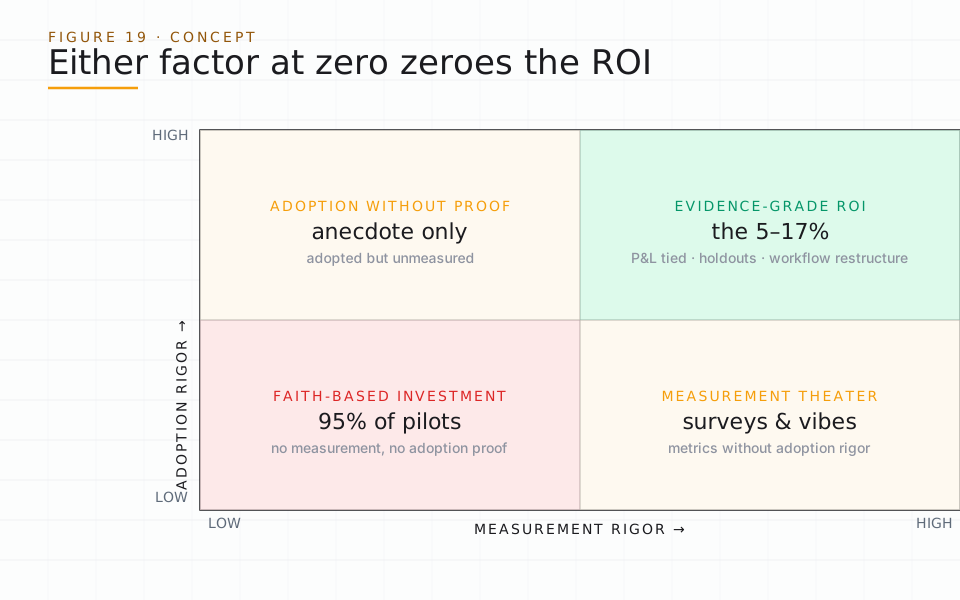
AI ROI = Measurement × Adoption Either factor at zero produces zero ROI, regardless of how impressive the other is.
The equationMeasurement without Adoption is theater — beautiful dashboards measuring a feature nobody uses in their real workflow. Adoption without Measurement is faith — usage climbing while no one can prove the business outcome. Both fail in the budget review.
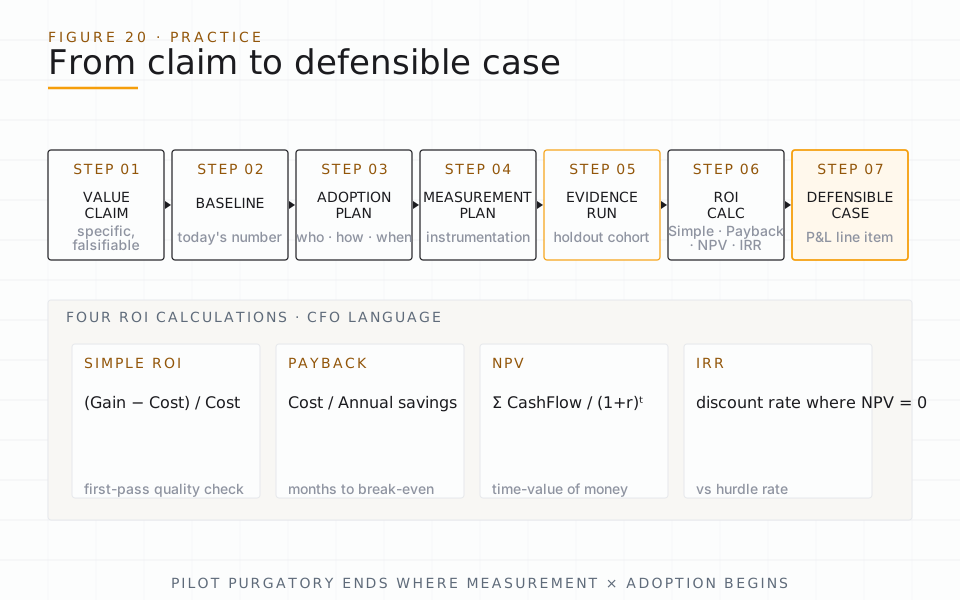
The Value Model is the 7-step process that operationalizes the equation:
- Define the value claim. What P&L line is moving, by how much, by when?
- Establish the baseline. Pre-AI numbers, with method documented. Without baseline, no comparison is defensible.
- Build the Adoption plan. Workflow restructuring (Indispensability Index from L1-T03). Pilot users. Champions. Training. The plan to make the AI actually used.
- Build the Measurement plan. Holdout cohort. P&L attribution. Eval suite. The plan to prove the AI caused the value.
- Run the pilot. 8–12 weeks. Both Adoption and Measurement plans active.
- Calculate the four ROI numbers. Simple ROI, Payback period, NPV (Net Present Value), IRR (Internal Rate of Return). Each tells a different story.
- Decide: scale, iterate, or kill. Evidence-grade decision, not a faith-based one.
The Value Model is the 7-step operating discipline that produces evidence-grade AI ROI. The core equation is Measurement × Adoption — either factor at zero zeroes the ROI. The model produces four ROI calculations (Simple ROI, Payback, NPV, IRR) that close the loop with finance and turn AI from a faith-based budget line into a defensible investment case. The 5–17% of pilots that escape pilot purgatory share this discipline.
The definitionSeparate three claims:
Effort: Time or compute used or saved. Easy to count, but easy for finance to challenge.
Output: A draft, recommendation, updated record, or handled conversation. Visible and countable, but capable of creating no business result.
Outcome: An issue that remains resolved, a payment collected, a defect prevented, or a customer retained. This is what buyers want and what is hardest to attribute.
A recommended lead is an output. A qualified lead is an outcome. A drafted response is an output. A customer who does not need to contact support again can be an outcome.
A complete value model names the outcome, the output expected to create it, the cost of producing that output, and the evidence that the outcome happened.
Count only outputs and the team will overstate value. Promise outcomes it cannot observe and it will overstate control.
Complete: “This output should create this outcome for this user, shown by this evidence, at this cost.”
A clinical trial. The trial doesn't measure whether the drug seems to work. It measures whether the drug causes improvement, with a control group, blinded protocol, predefined primary endpoint, and statistical significance. Without those, the trial is opinion. With them, the trial is evidence. AI ROI works the same way. Without holdout cohorts, baseline measurement, and predefined endpoints, the ROI claim is opinion. With them, it's evidence the CFO can act on.
Think of it like:The concept — visualized
The four ROI calculations
Simple ROI = (Net value delivered) / (Total investment). The headline number. Easy to communicate. Hides the time dimension. Use as the lead but never as the only number.
Payback period = the time to recover the investment. Critical for AI because the Inference Treadmill (L1-T07) keeps running — a long payback period exposes the team to obsolescence risk. Most defensible AI initiatives have payback under 18 months.
NPV (Net Present Value) = the present value of future cash flows minus the investment. Required for multi-year initiatives. Forces the team to project cost trajectory (which the Day-1 cost discipline from L1-T08 should have already produced).
IRR (Internal Rate of Return) = the discount rate that makes NPV zero. Useful for comparing AI initiatives against other capital-allocation alternatives (which is how the CFO actually evaluates them). Most defensible AI initiatives target IRR above 25%.
Each calculation tells a different part of the story. A team that reports only Simple ROI is leaving evidence on the table. A team that reports all four is making a defensible capital-allocation case.
Reject the FTE Fallacy
The Value Model deliberately excludes "FTE replacement" framing from the value claim. The L1-T02 chapter explained why: AI rarely replaces FTEs cleanly; it rearranges workflows. The replacement framing produces ROI numbers the team can't defend at the 18-month mark.
The replacement: workflow restructuring framing. Instead of "saves 15 FTEs," report:
- Cycle time delta (process now takes 20% less time)
- Escalation rate delta (50% fewer cases escalate to humans)
- Skill-mix change (remaining humans do higher-value work)
- Training cost delta (new hires need 30% less ramp time)
- P&L line moved (gross margin up 4 points; support cost per ticket down 60%)
These metrics are harder to fit on a slide. They're also defensible six months later. The Klarna lesson — "AI replaced 853 FTEs" → re-hiring humans for nuance — is what happens when teams use replacement framing. The honest math protects the team from the dishonest deck.
Where this hits in production
The 5–17% pattern is observable. The teams that ship into profitable production share three behaviors: holdout cohorts (Measurement rigor), workflow restructuring (Adoption rigor), and finance partnership (ROI defensibility). Holdout cohorts are the single highest-leverage Measurement discipline — without them, the counterfactual is hand-waved. Workflow restructuring is the Adoption equivalent — measured by the Indispensability Index from L1-T03. Finance partnership turns ROI from a marketing artifact into a CFO-grade investment case.
JPMorgan's COiN saved 360,000 lawyer-hours. The number is defensible because the team measured it with rigor. Pre-AI baseline (lawyer-hours per contract review). Post-AI measurement (same metric, same definition). Holdout (contracts manually reviewed for comparison). The number isn't impressive because it's big — it's impressive because it's defensible.
ServiceNow's 90% IT autonomous resolution. Same pattern: pre-AI baseline (% of tickets resolved without human intervention), post-AI measurement, holdout cohort to validate. The number isn't a marketing claim — it's a documented business outcome with a defensible methodology.
XPO Logistics' built-in attribution. XPO designed AI features with attribution baked into the architecture. Every AI-assisted decision logs the alternative (what would have happened without AI) so the ROI can be calculated continuously. The architecture is the measurement. This is the gold-standard pattern for evidence-grade ROI.
Klarna's mixed story is the counter-pattern. The 2024 announcement (FTE replacement framing) didn't survive 2025 (re-hiring for nuance). The lesson: framing matters. Workflow restructuring framing would have produced a more nuanced and more defensible result. The replacement framing produced a public credibility hit.
The trap
Trap 1: Measurement without Adoption. Beautiful dashboards measuring a feature nobody uses in their real workflow. The value claim is real (the AI works); the adoption is fake (workflows haven't restructured). ROI is zero. The fix is the Adoption plan in step 3 — workflow restructuring with documented Indispensability Index trajectory.
Trap 2: Adoption without Measurement. Usage climbing while no one can prove the business outcome. The team feels good. The CFO doesn't. ROI is faith-based. The fix is the Measurement plan in step 4 — holdout cohort, P&L attribution, eval suite, finance partnership.
Trap 3: FTE replacement framing. "Saves 15 FTEs" is the headline that doesn't survive 18 months. The fix is workflow restructuring framing — cycle time, escalation rate, skill mix, training cost, P&L line moved.
Trap 4: Reporting Simple ROI alone. The headline number hides the time dimension. The fix is to report all four (Simple ROI, Payback, NPV, IRR). Each tells part of the story. The CFO needs all four.
Trap 5: Skipping finance partnership. ROI claims authored only by the AI team produce credibility theater. ROI claims co-authored with finance produce defensible investment cases. The fix is structural — finance is on the Value Model team from step 1.
Remember this
- AI ROI = Measurement × Adoption. Either factor at zero zeroes the ROI. Build both with rigor.
- The 7-step Value Model: define value claim, establish baseline, build Adoption plan, build Measurement plan, run pilot, calculate four ROI numbers, decide.
- Four ROI calculations: Simple ROI, Payback, NPV, IRR. Report all four. Each tells a different story.
- Reject the FTE Fallacy. Workflow restructuring framing. Cycle time, escalation rate, skill mix, training cost, P&L line moved.
- Finance is on the team from step 1. ROI claims authored only by the AI team produce credibility theater. Co-author with finance produces investment-grade evidence.
- The 5–17% that escape pilot purgatory share three behaviors: holdout cohorts (Measurement), workflow restructuring (Adoption), and finance partnership (defensibility).
In practice
Step 1: Define the value claim. What P&L line is moving, by how much, by when? Specific numerical commitment. "Reduce cost per resolved support ticket by 40% within 6 months." Vague claims produce theatrical ROI.
Step 2: Establish the baseline. Pre-AI numbers, with method documented. Without baseline, no comparison is defensible. Take the time to measure correctly.
Step 3: Build the Adoption plan. Target users. Champions. Training. Workflow restructuring goals (Indispensability Index trajectory). Define what "adopted" means specifically.
Step 4: Build the Measurement plan. Holdout cohort that doesn't get the AI. P&L attribution methodology. Eval suite for quality. Finance partner co-authoring the analysis.
Step 5: Run the pilot for 8–12 weeks. Both plans active. Weekly review. Adjust as needed but don't change the endpoint definition mid-pilot (that's measurement theater).
Step 6: Calculate the four ROI numbers. Simple ROI, Payback, NPV, IRR. Document the methodology. Show the work.
Step 7: Decide: scale, iterate, or kill. Evidence-grade decision, not faith-based. The kill option is the feature — most pilots that don't show evidence-grade ROI in 12 weeks won't show it at 24.
Step 8: Translate the result for the CFO. Numbers + conditions. "Simple ROI of 280%, Payback 11 months, NPV $4.2M over 3 years at 12% discount rate, IRR 38%, validated against holdout cohort showing 41% reduction in cost per resolved ticket. Recommendation: scale to 100% of customer base." That's the conversation the CFO can act on.
The practice — visualized
References
- What decision does this value claim change — scale, iterate, or kill?
- What evidence separates the output you counted from the outcome you promised?
- What does the ROI number still not prove about causation?