- 01.Why per-seat pricing dies in AI products: the structural mismatch between log-normal cost distributions and uniform per-seat revenue
- 02.The SaaSpocalypse: pricing decisions now precede product decisions, because the wrong pricing model can make the right product unprofitable
- 03.Klarna's 853-FTE replacement preview: how the value AI delivers in production rarely matches the per-seat assumption it was sold under
- 04.The four pricing transitions every AI product must navigate: per-seat → tiered usage → outcome-based → abstracted-value
- 05.Why "we'll fix pricing after PMF" is the second-most-expensive sentence in AI product management (after "we'll figure out the ethics later")
The story
Consider a SaaS firm whose AI assistant is bundled into a $40/user/month seat. Adoption climbs. Engagement is healthy. Six months in, the per-user inference cost is a flat $3 average. Margin is fine. The team is celebrating.
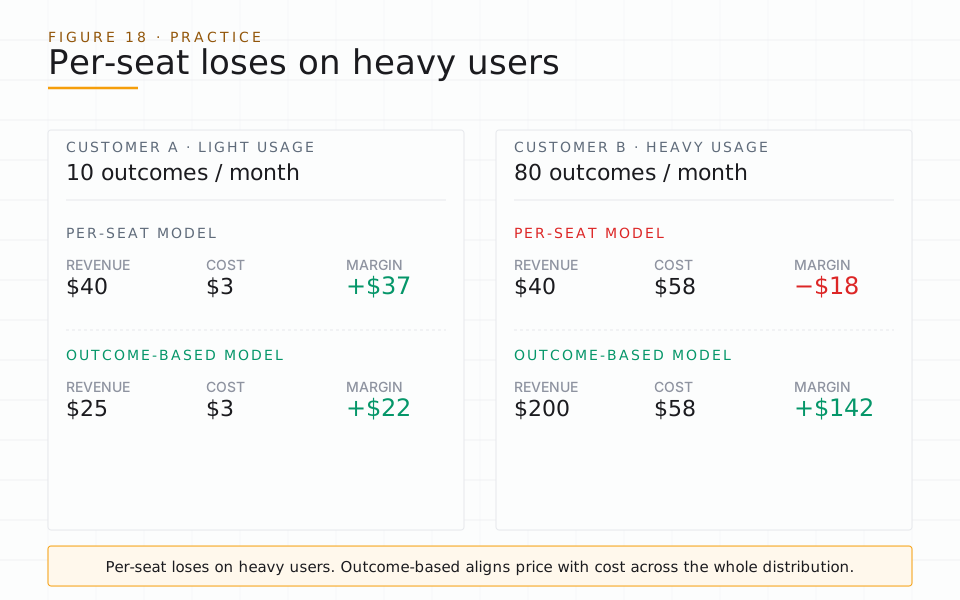
Then a major customer rolls out the AI assistant to 1,000 users — the largest deployment to date. The customer's usage profile is different from the average: their ops team runs multi-hour agentic sessions; their analyst team uses the assistant for deep research with long context. Within 30 days, that one customer accounts for 35% of total inference spend. Their per-user cost: $58/month. They pay $40,000 for 1,000 seats. The team is paying $58,000 in inference. That one customer is unprofitable by $18,000/month.
The pricing team sees the problem. They want to charge the customer more. The customer pushes back: "You sold us $40/seat. We're at $40/seat." The pricing team's options are bad: introduce overage charges retroactively (renewal risk), absorb the loss (margin damage), or restructure the offering (12-month sales cycle). Every option costs money. The fundamental issue isn't pricing tactics — it's that per-seat pricing was structurally wrong for an AI product where usage distributions are log-normal.
Consider the public Klarna case. The 2024 announcement: AI replaces 853 FTEs. The 2025 reality: re-hiring humans for nuance work. The pricing implication beneath the headline: Klarna negotiated their AI vendor contracts under the assumption that the AI would handle the full customer service workload, but the actual reality was that the AI handled 65% and humans handled the nuance 35%. The vendor's pricing was calibrated for the announced replacement scenario. The actual usage was different. Both sides ended up renegotiating.
This is the SaaSpocalypse — pricing decisions now precede product decisions because the wrong pricing model can make the right product unprofitable, and the right pricing model is hard to ship after the product launch. The team that picks pricing last, after PMF, after launch — discovers the pricing was wrong six months too late.
Consider a third team that adopts a hybrid pricing model from Day 1: a base subscription for predictable users, usage-based billing for power users, outcome-based pricing for the 20% of cases where the value is measurable per-outcome. The team's gross margin is healthier than competitors using per-seat. Their power users pay for what they consume. Their casual users pay a low base. Their high-value users pay per-outcome and produce the highest margin. Pricing is a competitive moat rather than a renewal risk.
The core idea
Per-seat pricing assumes uniform cost distribution across users. SaaS satisfied that assumption: marginal cost was near zero, so per-seat was effectively free for the vendor. AI breaks the assumption: cost distribution is log-normal, marginal cost is significant, and the most engaged users (the cohort SaaS PM optimizes for) are often the most unprofitable.
Per-seat pricing is not dead. It is becoming incomplete.
A seat still prices something real: access, identity, support, and a line item procurement understands. What it no longer prices well is variable compute. Two customers with the same number of users can create very different costs once agents start doing work.
The practical market shift is hybrid: a seat or platform fee for access, plus a meter for effort, output, or—in a narrower set of workflows—business outcome.
Another distinction matters. Much of what vendors call usage pricing is actually capacity pricing. The customer buys a pool of credits and usually does not recover unused capacity. That gives the vendor predictable revenue and the customer a predictable budget. It is not the same as paying only for actual use.
The PM’s job is not to announce the end of seats. It is to explain what access costs, what work costs, and why the chosen meter matches customer value.
Write one sentence explaining what the seat buys and another explaining what the variable meter buys. If both describe the same thing, the pricing model is confused.
The fix isn't a single new pricing model. It's a transition arc that AI products must navigate as they mature:
1. Per-seat (legacy) — uniform monthly fee. Works only when AI usage is incidental and bounded. Most teams launch here and discover the unit economics fail at scale. 2. Tiered usage — base tier with usage cap, overage pricing or higher tier for power users. Aligns price with cost. The first response to per-seat failure. 3. Outcome-based — pay per successful outcome (resolved ticket, processed document, completed deal). Decouples price from token consumption. Hardest to attribute; most defensible at scale. 4. Abstracted-value — package AI capability into a higher-level unit (workflow completion, agent-as-service) and price the unit. Hides the token economics from the customer; aligns price with value, not consumption.
The pricing transition arcEach transition is a 1–2 quarter project. The team that starts the transition before per-seat fails has runway. The team that starts after per-seat fails has crisis pricing.
The SaaSpocalypse is the structural shift in AI product economics where per-seat pricing — the dominant SaaS pricing model — fails because cost distributions are log-normal rather than uniform. The response is a four-stage pricing transition (per-seat → tiered usage → outcome-based → abstracted-value), each stage matching pricing more tightly to the underlying cost and value distribution. The transition is mandatory for AI products at scale; the only question is whether the team starts it proactively or reactively after the margin problem becomes public.
The definitionElectric utility pricing. Imagine a power company that charged a flat $40/month per household regardless of consumption. Households with central AC and electric heat would pay the same as households with two lamps. The economics would collapse — heavy users would migrate to the flat-rate provider while the provider lost money on every customer above average usage. Real utilities solved this with tiered consumption pricing — base rate plus per-kWh charges. Per-seat AI pricing has the same structural mismatch. The transition is the same: from flat-rate to consumption-based.
Think of it like:The concept — visualized
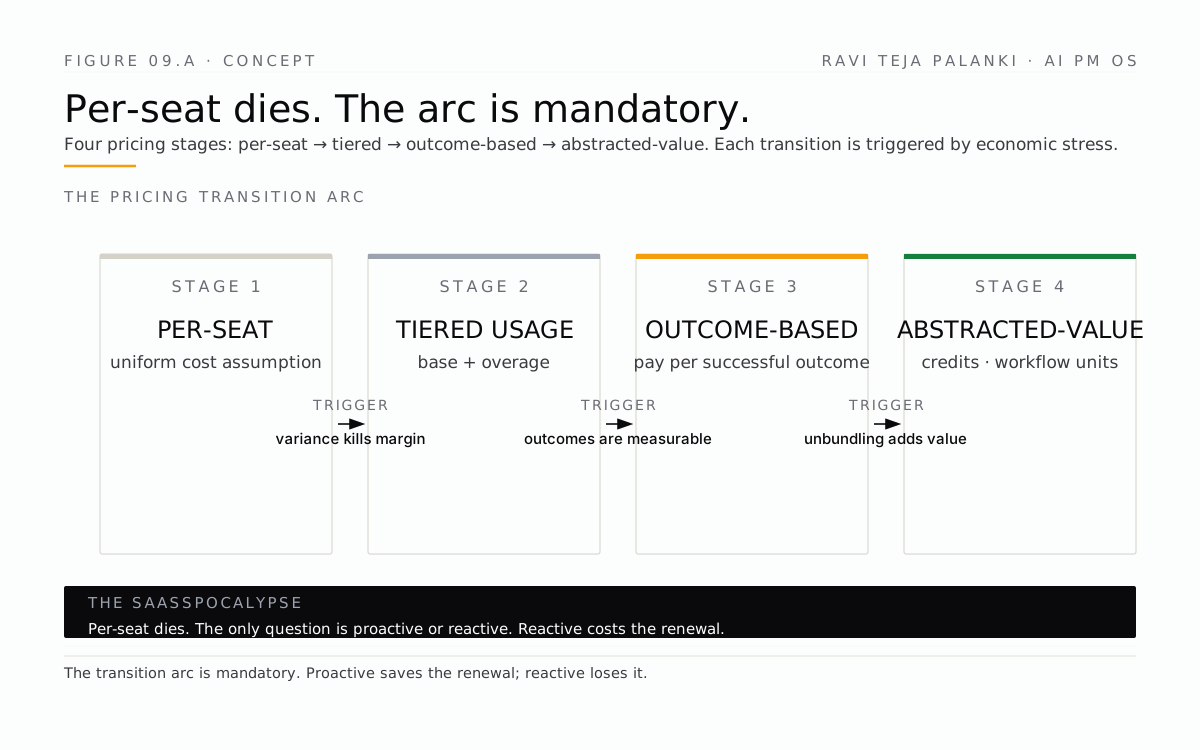
The four pricing transitions
Transition 1: Per-seat → Tiered usage. The first move. Add a usage cap to the per-seat tier. Power users pay overage, or they upgrade to a higher tier with higher caps. The team's pricing now scales with cost. Most enterprise AI products land here within 12 months of launch. The friction: existing customers grandfathered in at unlimited per-seat are a renewal-risk cohort.
Transition 2: Tiered usage → Outcome-based. The pricing decouples from token consumption. The customer pays per successful outcome — resolved ticket, processed invoice, completed deal. The vendor's incentive aligns with quality (fewer wasted tokens means higher margin). The customer's incentive aligns with value (they pay only when the AI works). Intercom Fin moved to $0.99/resolution and grew from launch to $343M ARR with this model. The friction: outcome attribution is hard. What counts as "resolved"? Who arbitrates? The L2-T09 outcome-based pricing playbook covers the operational mechanics.
Transition 3: Outcome-based → Abstracted-value. The pricing packages AI capability into a higher-level unit. Salesforce's 100K credits / $500 is the canonical example: the customer buys a bucket of credits, applies them across AI features, and never sees token economics. The vendor optimizes the cost behind the scenes. The customer optimizes the value they extract. This is the mature pricing endpoint for AI platforms.
Transition 4: Abstracted-value → Service-as-Software. The most aggressive transition. The customer doesn't license software at all — they pay for the outcome the software delivers, the way they'd pay an outsourced service. JPMorgan's COiN saved 360,000 lawyer-hours through software, but the model is closer to "service" than "license." This is the L3-T07 Golden Quadrant territory and the SaaSpocalypse's full expression.
Where this hits in production
The renegotiation cost is structural. A team that ships per-seat and discovers the pricing fails has three bad options: retroactive overage (renewal risk), margin absorption (gross-margin damage), or full pricing redesign (12-month sales cycle). All three damage the business. The fix is to anticipate the transition rather than respond to crisis. Tiered usage caps from Day 1 buy runway.
The Klarna lesson is about pricing-product mismatch. The vendor priced for an announced reality (full FTE replacement). The actual reality (volume + nuance hybrid) didn't match. Both sides renegotiated. The lesson: pricing must match the realistic usage profile, not the headline ambition. The team that prices for the announced reality is pricing on a shaky foundation.
The Intercom Fin pattern is the public case for outcome-based pricing. $0.99 per resolution. Customer pays only when the AI resolves the ticket. Vendor margin scales with AI quality. From launch to $343M ARR with 393% Q1 growth. The pricing model is the moat — competitors using per-seat can't match the customer-aligned incentive structure.
The Cursor pattern is the public case for the per-seat → tiered usage transition. The team launched with per-seat. Power users broke the unit economics. The team responded with usage-based pricing changes and pricing tier redesigns. The transition was reactive, not proactive — and the public coverage damaged the brand. Proactive transition costs less than reactive transition.
The trap
Trap 1: Treating pricing as a launch decision rather than an operating model. Per-seat pricing fails eventually, not immediately. Teams that ship per-seat and never plan the transition discover the problem when the CFO asks. The fix is to plan the transition arc from Day 1 — knowing the team will be at tiered usage in 12 months and outcome-based in 24, even if launch is per-seat.
Trap 2: Trying to skip stages. The per-seat → outcome-based jump is too aggressive for most products. Tiered usage is the bridge that builds customer comfort with consumption-aware pricing. Skip the bridge and the outcome-based pricing introduces too much change management at once.
Trap 3: Pricing for the announced reality, not the actual usage profile. The Klarna lesson. "AI replaces 853 FTEs" is a headline; the actual usage is volume + nuance. Pricing on the headline produces immediate renegotiation. The fix is to price for the actual usage profile, validated through pretotyping (L1-T05) and pressure-testing (L1-T06).
Trap 4: Letting engineering set pricing. Engineering optimizes for what they're measured on. Without pricing as a Day-1 product concern, the pricing team gets handed a product that's already shipped and asked to make it profitable. The fix is for the PM to own pricing — including the transition arc — as a product responsibility.
Remember this
- Per-seat pricing is not dead — it is becoming incomplete. Log-normal cost distributions mean a seat alone no longer prices variable compute well. The fix is a meter layered on top, not the seat’s disappearance.
- The SaaSpocalypse: pricing precedes product. The wrong pricing model can make the right product unprofitable. Plan the pricing transition arc from Day 1.
- Four-stage transition arc: per-seat → tiered usage → outcome-based → abstracted-value (and eventually Service-as-Software for the most ambitious products). Each stage is a 1–2 quarter project.
- Price for the actual usage profile, not the headline ambition. Klarna's 853-FTE announcement preview shows what happens when pricing assumes the announced reality and reality is different.
- The pricing model is the moat at scale. Intercom Fin's $0.99/resolution is a moat per-seat competitors can't match. Pricing decisions are strategic, not tactical.
In practice
Step 1: Map your pricing model against the four-stage arc. Where are you today? Where should you be in 12 months? In 24? The plan is the answer to "what's the pricing transition project for this year."
Step 2: Add tiered usage caps to per-seat tiers. The simplest first move. Define the cap (e.g., 100 sessions/user/month). Define the overage rate. Define the upgrade path. The cap aligns price with cost without disrupting customer expectations.
Step 3: Pilot outcome-based pricing on a high-attribution use case. Pick a use case where outcome attribution is clean (resolved ticket, processed invoice). Run a pricing experiment with a friendly customer. Validate the model before scaling.
Step 4: Plan the transition language. Customer-facing communication for each transition is non-trivial. The team that plans the comms before the transition has smoother renegotiations. The team that improvises has churn.
Step 5: Make pricing a Day-1 product concern. Pricing on the PRD. Pricing in the OKRs. Pricing reviewed quarterly alongside the harness metrics from L1-T01. The shift in operating model — pricing as product responsibility, not pricing-team chore — is what separates teams that navigate the SaaSpocalypse from teams that get hit by it.
The practice — visualized
References
- What decision does this pricing change actually change?
- What evidence would tell you the seat no longer matches cost?
- What does the transition arc still not prove about your product?