- 01.Why traditional product-market fit signals (NPS, retention, expansion) under-detect AI PMF — and the new standard that replaces them: agent-native indispensability
- 02.The Indispensability Index — a single defensible number that tells leadership whether the AI feature has crossed the threshold from "useful" to "the workflow can't go back"
- 03.The 7 Fits adapted for AI products: problem fit, solution fit, market fit, channel fit, model fit, harness fit, economic fit
- 04.The Agent Tax anti-pattern — when teams build AI features users tolerate but don't depend on, and how the Indispensability Index detects it before the renewal conversation
- 05.Why "outcomes-not-outputs" roadmaps are the only way to measure AI PMF, and what changes in roadmap reviews when you adopt the discipline
The story
Consider a B2B SaaS team that ships an AI summarization feature for sales call transcripts. NPS is high. Adoption climbs to 60% of the user base in the first quarter. Retention metrics look healthy. The team declares PMF.
Six months in, a competitor launches a similar feature. Within four weeks, the team's AI feature usage drops 30%. Customers cancel their subscriptions to that specific add-on. Retention on the core product is unaffected — users keep buying the SaaS — but the AI add-on revenue collapses. The team's PMF was a substitution PMF. Users liked the feature when it was offered. They didn't need it. The moment a competitor offered a similar feature, switching cost was zero.
This is the Agent Tax anti-pattern. Users tolerate the AI. They don't depend on it. The dashboard says PMF. The economics say "another tax line item the customer will cut at first opportunity." Traditional PMF metrics — adoption, retention, NPS — under-detect this pattern because they measure whether the feature is used, not whether the workflow has restructured around it.
A second team takes a different approach. They build an AI agent for invoice extraction at a logistics company. The agent isn't fast or flashy at launch — extraction accuracy is 71% in the first month. The team focuses on a different metric: what percentage of the invoice processing workflow now assumes the agent's output is the source of truth? In month 1, that number is 12%. In month 2, 34%. By month 4, 78%. By month 6, the workflow can't function without the agent — finance has retired the manual extraction template, the audit team has rebuilt their reconciliation process around the agent's confidence scores, and three downstream systems consume the agent's output as their primary input.
Accuracy continued improving (91% by month 6). But the more important metric was workflow restructuring. The competitor who shipped a similar agent in month 9 couldn't displace this team — because displacement now required redesigning three downstream systems, not just swapping a vendor. The team had built agent-native indispensability. That's the PMF standard for AI products.
The core idea
Traditional PMF asks: do users keep using the feature? That question worked for SaaS because the cost of switching was the cost of switching software. AI products break this question because users can keep using a feature without depending on it — the Agent Tax pattern — and they can stop using a feature without churning from the core product.
Agentic PMF asks a different question: has the workflow restructured around the AI such that returning to pre-AI is measurably costly? If the answer is yes, you have indispensability. If the answer is no, you have an Agent Tax — a feature users tolerate that competitors can poach.
Agentic PMF is the standard where the AI feature has caused measurable workflow restructuring such that abandoning the AI imposes real cost on the user — not switching software, but redesigning processes, retraining people, and rebuilding downstream systems. The single metric is the Indispensability Index: the percentage of the target workflow whose downstream steps assume the AI's output as the source of truth. PMF on the SaaS standard means "users keep buying it." PMF on the agentic standard means "the workflow can't go back."
The definitionThe difference between liking a coffee shop and building your morning routine around one. The coffee-shop-liker is loyal until a closer one opens. The routine-builder has retrained their schedule, their commute, and their meeting cadence around the coffee shop's hours and location. When a competing shop opens, the routine-builder has to redesign their morning to switch — friction the liker doesn't pay. Agentic PMF is the routine-builder pattern. The Agent Tax is the loyal-but-replaceable pattern. They look identical until a competitor shows up.
Think of it like:Agentic product-market fit is not “users enjoy the assistant.” It is “a valuable job is completed repeatedly, inside the real workflow, at a cost and level of risk the buyer will continue to accept.”
Chain length matters. In a simple workflow where ten independent steps must all succeed, 95% reliability at each step gives roughly 60% end-to-end reliability. At twenty steps, it falls to about 36%. Users do not experience the reassuring 95% step score. They experience whether their work finished.
Real workflows are more complicated than this arithmetic. Steps may be related; retries may recover failures; some steps may be optional. But the lesson survives: every additional required step needs to earn its place.
Test agentic PMF across four dimensions:
- Completion: Can the product prove the job finished, rather than merely producing an answer?
- Repeatability: Does it work across ordinary cases, not one prepared demo?
- Economics: Is cost per completed job inside a range the customer will renew?
- Authority: Did it complete the job without doing anything outside the agreed boundary?
A satisfaction survey can show demand. It cannot prove reliable work.
Draw the main workflow and mark every required step. Remove any step that adds coordination but not user value. Then measure end-to-end completion on real cases.
The concept — visualized
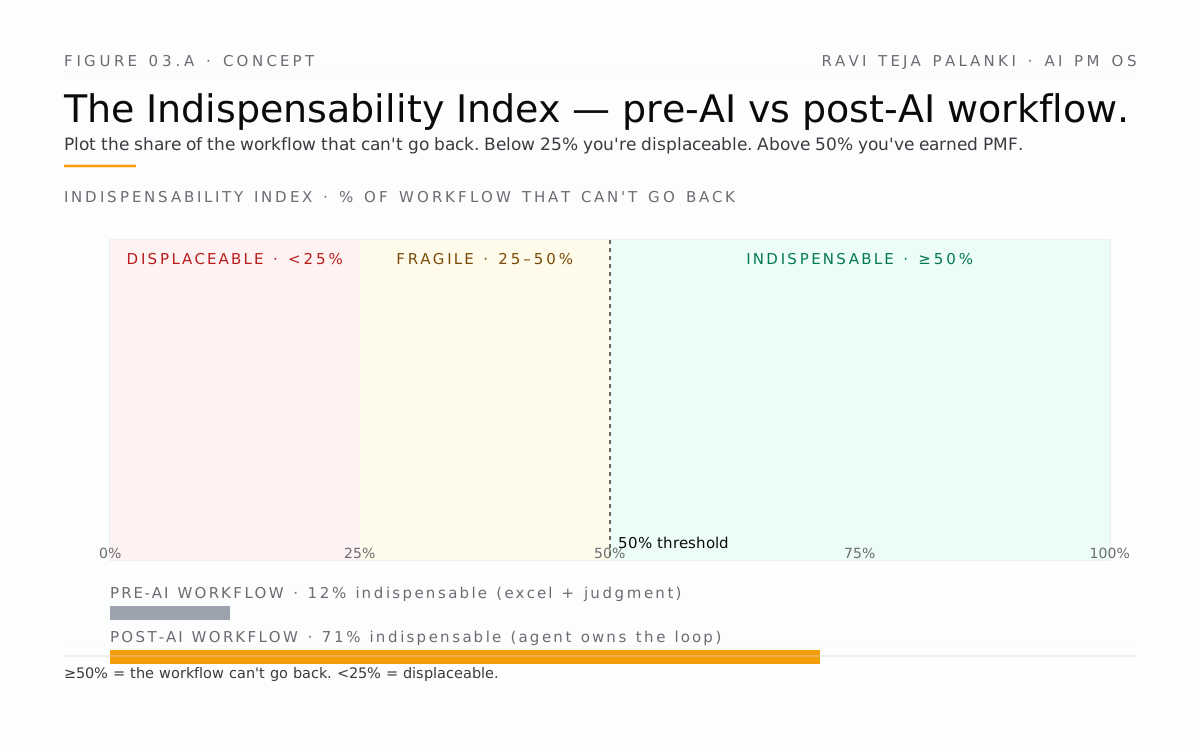
The Indispensability Index
The Indispensability Index is the single defensible number for agentic PMF. It's calculated as:
Indispensability Index = (Workflow steps that consume the AI's output as source-of-truth) / (Total workflow steps in the target use case)
Three calibration points:
- Below 25%: The AI is a feature users see. Workflow hasn't restructured. Switching cost is low. This is Agent Tax territory.
- 25–60%: The AI is integrated into the workflow but not load-bearing. Some steps depend on it. Switching is friction-laden but possible. This is the building zone.
- Above 60%: The workflow assumes the AI is present. Removing it requires redesigning downstream steps, retraining users, and rebuilding integrations. This is indispensability.
The Index is harder to fake than retention or NPS. You can't survey a workflow into restructuring itself. The number reflects whether downstream systems have been rebuilt around the agent's output — which is observable in API logs, integration architectures, and process documentation. A finance team that retires the manual-extraction template, an audit team that builds reconciliation on the agent's confidence scores, three systems consuming the agent's output as primary input — these are workflow restructuring artifacts. They produce the Index naturally; they can't be faked.
The 7 Fits adapted for AI products
Marc Andreessen's traditional PMF concept ("product-market fit means being in a good market with a product that can satisfy that market") maps loosely to AI but misses the layers underneath. The 7 Fits framework is the AI-native expansion:
- Problem fit — Is this a problem that genuinely needs solving, or are we solving it because the AI lets us? (See L1-T04 for the Boring AI discipline.)
- Solution fit — Does the AI's solution actually match the user's mental model of "good"? (See Evals as the New PRD (AI Evals L3-T29) for the eval-as-spec discipline.)
- Market fit — Is the willingness-to-pay sufficient to cover inference cost plus margin? (See L1-T08, L2-T04, L3-T07 for the pricing thread.)
- Channel fit — Does the GTM motion match the buying behavior of the segment? Is the user the buyer, or is the buyer the IT department? (See L3-T05 for GTM-AI Fit.)
- Model fit — Is the underlying model capable enough to deliver the experience without falling back to a more expensive model that breaks unit economics? (See L3-T03 for multi-model orchestration.)
- Harness fit — Is the harness mature enough to deliver reliable autonomous outcomes at the volume and complexity the use case demands? (See L1-T01, L3-T01.)
- Economic fit — Do the unit economics work at scale, not just in pilot? (See L1-T07, L1-T08, L2-T05.)
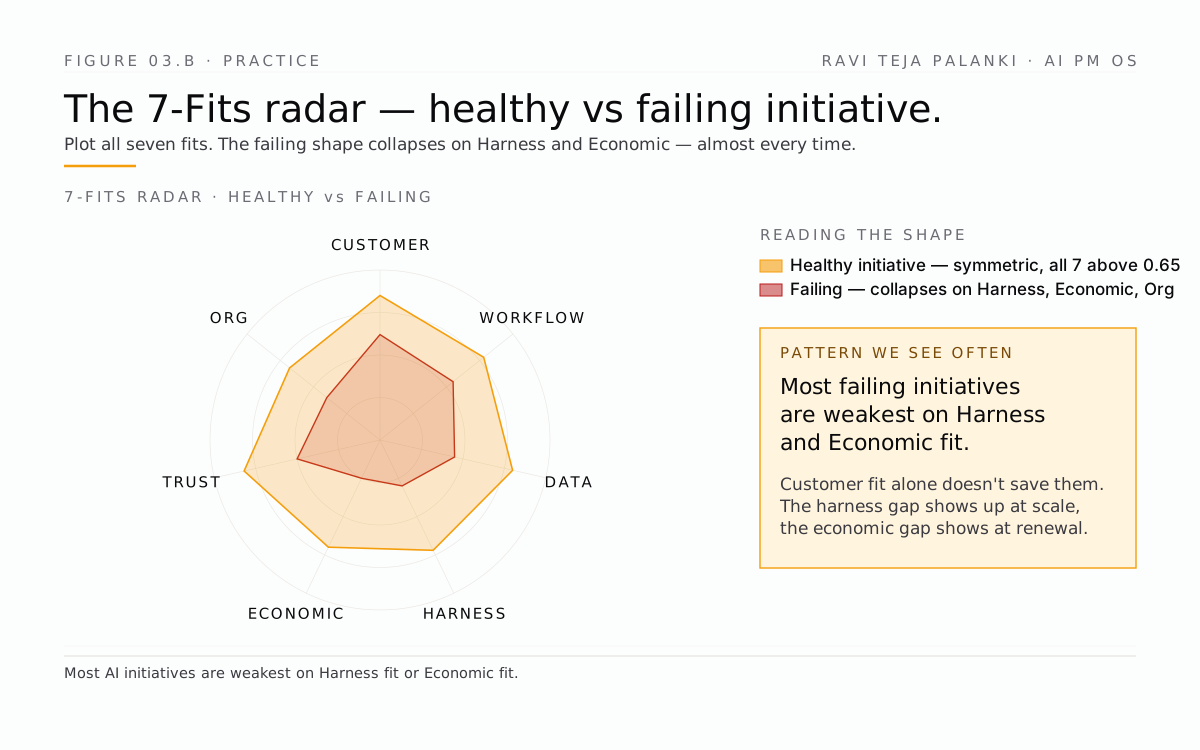
A team can have 6 of 7 fits and still fail. Most AI initiatives die because they have problem fit and solution fit but lack economic fit or harness fit — the AI works, users want it, the unit economics don't.
Where this hits in production
The 5–17% of AI initiatives that ship into profitable production share a measurement profile. They track the Indispensability Index from week 1, not week 26. They report all 7 Fits in their quarterly reviews. They have a defensible answer to "what would it take for users to abandon the AI?" — usually expressed as the redesign cost of downstream systems.
Klarna's mixed AI story is a 7-Fits diagnostic. The 2024 announcement claimed AI replaced 853 FTEs (problem fit ✓, solution fit ✓, economic fit appeared ✓). The 2025 reality — re-hiring humans for nuance work — surfaced that harness fit and solution fit were weaker than the headline suggested. The agent handled volume but not nuance. Volume work didn't require deep workflow restructuring (low Indispensability Index for the nuance segment). The savings were real for one segment and overstated for another. A 7-Fits review would have caught this in month 2, not 14.
The Cursor case study is a 7-Fits diagnostic of a different kind. Problem fit ✓, solution fit ✓ (developers loved it), market fit ✓ (willingness-to-pay was high), channel fit ✓ (PLG worked). Model fit and harness fit started strong and degraded as power-user usage patterns emerged — the harness wasn't built for multi-hour agentic sessions. Economic fit collapsed. The fix was harness re-engineering: context compression, semantic caching, loop pruning. Once the harness fit was restored, the economic fit followed.
The Apple Intelligence pattern is the 7-Fits aspiration. All seven fits are addressed in the architecture: Stateless AI plus Private Cloud Compute (harness fit and economic fit), the model swap from Gemini to in-house Ferret-3 (model fit), workflow integration deep in iOS (problem fit, solution fit, channel fit), monetization through device margin (market fit). The architecture treats the harness as the moat — exactly the L1-T01 lens.
The trap
The trap is celebrating adoption as PMF. Adoption is necessary but insufficient. A 60% adoption rate with a 15% Indispensability Index is the Agent Tax pattern. Users see the feature, click it occasionally, and would notice if it disappeared but wouldn't redesign their workflow. The first competitor with a similar feature and aggressive pricing takes the segment.
The fix is to instrument the Indispensability Index from week 1. Every workflow review should include the question: which downstream steps now assume the AI's output as source-of-truth? If the answer is "none" or "very few" after three months, the team is shipping toward Agent Tax, not toward indispensability.
The second trap is treating indispensability as a binary state. It's not — it's a continuum, and the Index is a continuous measurement. A team at 35% should be running experiments to push to 50%. A team at 65% should be reinforcing the workflow ties so the Index doesn't slip backward. The competitive risk doesn't disappear at 60%; it changes shape — from displacement risk to continuous-improvement risk.
The third trap is conflating user attachment with workflow attachment. Users may love a feature emotionally and abandon it functionally. The Indispensability Index measures the workflow, not the affect. A user who says "I love this feature" but whose downstream systems don't consume the output is still in Agent Tax territory.
Remember this
- Traditional PMF metrics under-detect AI PMF. Adoption, NPS, retention can all be high while the Indispensability Index is low — the Agent Tax pattern. Build the Index into the dashboard from week 1.
- Agentic PMF means workflow restructuring, not feature usage. The standard is: can the workflow go back to pre-AI without measurable cost? If yes, you don't have PMF. If no, you do.
- The 7 Fits are the diagnostic. Problem, solution, market, channel, model, harness, economic. A team with 6 of 7 still fails. Most teams die on harness fit or economic fit.
- The Indispensability Index is observable, not surveyed. API logs, integration architectures, and retired manual processes produce it naturally. You can't fake the Index because you can't survey a workflow into restructuring itself.
- Outcomes-not-outputs roadmaps. Stop reviewing what the AI did this quarter. Start reviewing what the workflow did because of the AI this quarter. The shift is the operating-model upgrade that makes Level 1 stick.
In practice
Step 1: Calculate your Indispensability Index for each AI initiative. Pick the target workflow. List the workflow steps. For each step, ask: does this step now consume the AI's output as source-of-truth? Calculate the percentage. If the Index is below 25% after 3 months, you're shipping toward Agent Tax. Above 60% means you've crossed into indispensability.
Step 2: Run a 7-Fits review on each initiative. Score each fit 1–5. Identify the weakest fit. Most AI initiatives are weakest on harness fit or economic fit. The weakest fit is the workstream for next quarter.
Step 3: Reframe the roadmap as outcomes-not-outputs. Stop reporting "AI shipped feature X." Start reporting "the workflow moved Indispensability Index from 32% to 47% on the target use case, driven by feature X plus integration into systems Y and Z." Outputs are activity. Outcomes are the workflow change that activity produced.
Step 4: Add the Index and 7 Fits to the quarterly review. A defensible AI portfolio review reports, for each initiative: Indispensability Index trajectory, weakest fit, plan to address weakest fit. Compare to previous quarter. Promote initiatives whose Index is climbing. Restructure or kill initiatives where the Index is flat after two quarters.
Step 5: Translate the Index into business language for leadership. No CFO knows what an Indispensability Index is. Translate: "The workflow is now 67% restructured around the AI. Switching to a competitor would require three integration rewrites and a process redesign — a 2-quarter project for the customer, which makes their renewal probability ~85% versus the ~62% baseline for AI add-ons across the industry." The Index turns abstract PMF into concrete renewal probability.
The practice — visualized
- What decision does the Indispensability Index change for a ship or scale call?
- What evidence would show completion, not just adoption or session count?
- What does a high index still not prove about cost or risk?