- 01.The three SaaS PM assumptions that AI breaks completely — marginal cost ≈ zero, deterministic output, human-user funnels — and why running SaaS playbooks on AI products produces garbage signal
- 02.Why the center of gravity has moved from the product to the harness — the orchestration + memory + skills + context + evals layer that turns raw model intelligence into reliable autonomous outcomes
- 03.The three harness metrics — Context Durability, Intervention Rate, Self-Optimization Rounds — that predict business outcomes 2–4 weeks ahead
- 04.The litmus question that separates 0.1% AI PM teams from average teams: "If we froze the model tomorrow and could only improve the harness, how much PMF lift could we unlock?"
- 05.Why harness mastery is not engineering territory — it's the PM's highest-leverage skill in 2026, and the muscle that earns budget instead of begging for it
The story
Consider a senior PM at a Fortune 500 SaaS company who's been running the AI product line for 18 months. She's a strong PM. She runs user interviews, ships features, watches retention curves, runs roadmap reviews on Mondays. The AI feature she launched a year ago — a sales-rep assistant that drafts customer emails — is in production. NPS is fine. Adoption is climbing. Then her CFO drops a slide on her desk.
The slide shows margin per user, segmented by AI engagement. Users who use the assistant heavily — the team's most "engaged" cohort — are unprofitable. The infrastructure cost per task scales linearly with usage. The most successful customers, by every SaaS metric, are the ones losing the company money.
This isn't a billing bug. It's a structural mismatch. The PM ran a SaaS playbook on a system whose unit economics break SaaS assumptions. She optimized for engagement on a feature whose marginal cost is not zero. She measured retention without measuring inference cost per outcome. By the time the CFO slide arrived, the team had already shipped six months of work that made the margin problem worse, not better.
Cursor's $7,225 invoice — a now-public case where one engineer ran up a four-figure monthly bill on a single AI dev tool — is the public version of this story. Replit reported negative 14% gross margins on its $252M ARR run rate. These are not edge cases. They're the predictable consequence of building AI products with SaaS reflexes. The ARR looks normal. The margin economics quietly burn the business.
The pattern is consistent across hundreds of teams I've talked to in the last 18 months. SaaS PMs apply user research to probabilistic systems and get garbage signal — because the system gives different outputs to the same prompt and the user research can't tell signal from noise. They run roadmap prioritization on features the agent will never use — because the system's actual behavior is not the behavior the PRD described. They negotiate per-seat contracts for products whose value gets delivered when no human is logged in — because increasingly, the user is another agent, invisible to the funnel.
When the assumptions break, the playbooks break. Three SaaS assumptions, three places they fail in AI:
| SaaS assumption | AI reality |
|---|---|
| Marginal cost ≈ zero per user | Inference is 80–90% of lifetime spend; P90 users cost 40× P50 users |
| Deterministic output (same input = same output) | Probabilistic output; "vibe checks" break in production; same prompt produces different outputs across runs |
| Human user clicks through your UI | Increasingly, the user is another agent — invisible to your funnel, your analytics, your support system |
An AI PM is not a SaaS PM with a prompt library.
In ordinary SaaS, a shipped rule normally stays put until the team changes the code. In an AI product, behaviour can change because the model provider shipped an update, the knowledge source went stale, a tool changed its response, or users found a new way to ask the same thing.
Cost can change without a pricing change too. GitHub Copilot still sells seats, but chat and agent work now also consumes pooled AI credits. Two teams with the same headcount can produce very different bills.
That changes the PM’s operating rhythm. Shipping is not the end of the work. The AI PM keeps owning four moving questions:
- Is quality holding across real users and tasks?
- What does one completed job cost?
- What is the system allowed to do without approval?
- What evidence shows the user’s job was actually completed?
These are not engineering details. They are the product.
If the monthly review contains adoption but not quality, cost per completed job, and failures by type, the team is still operating the AI feature like conventional SaaS.
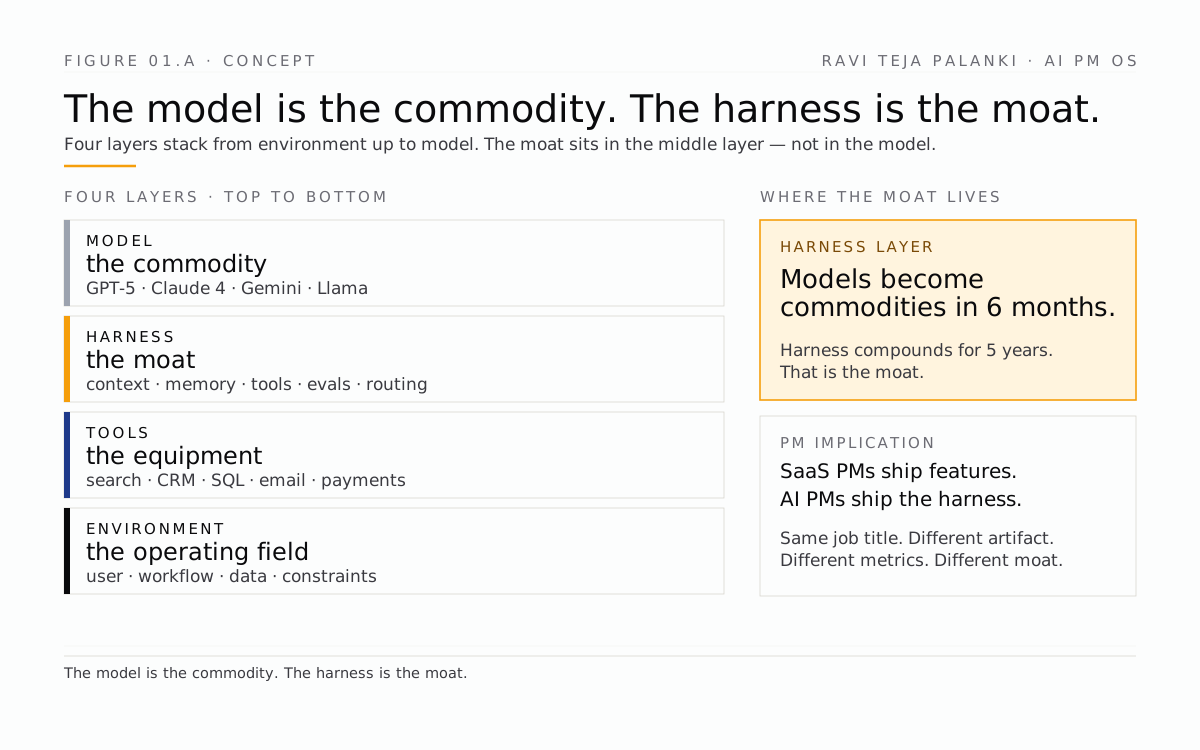
The 0.1% AI PMs don't run those playbooks. They've installed a different operating system. The center of gravity has moved one layer down — from the product to the harness: the orchestration + memory + skills + context + evals layer that turns raw model intelligence into reliable autonomous outcomes.
In 2026, the highest-leverage skill is not user research, not roadmap prioritization, not stakeholder management. It's harness mastery. Without it, you have a demo. With it, you have a moat.
The core idea
The four-layer model for any AI product:
| Layer | What it is | Examples |
|---|---|---|
| Model | The raw reasoning engine | GPT-5, Claude Opus, DeepSeek V3.2 |
| Harness | Orchestration + memory + skills + context + evals | Your prompt templates, RAG pipeline, eval harness, AGENTS.md, filesystem state, MCP integrations, error recovery |
| Tools | What the agent can actually do | API calls, MCP servers, code execution, retrieval endpoints |
| Environment | Where the agent runs | The user's IDE, your platform, the marketplace, the agent's web session |
The model is a commodity. Every frontier lab is shipping new SOTA every quarter. The price of intelligence is dropping. What's not commoditized is the harness.
The harness is what you own. It's where your domain knowledge lives. It's where your eval suite is built. It's where your prompt patterns, retrieval logic, error recovery, memory model, and tool permissions are designed. It's the layer that turns a frontier model — which any competitor can also access — into your product. And it's the layer where the 10× difference between teams becomes visible.
Harness mastery is the PM discipline of designing, measuring, and continuously improving the orchestration + memory + skills + context + evals layer that turns raw model capability into reliable autonomous outcomes. It's not engineering specialization — it's the PM-owned integration layer where intent (what the system should do), user context (who it's for), domain rules (what it must respect), and success criteria (what counts as winning) are translated into a system that ships.
The definitionHiring an intern vs. building an operating environment for a senior consultant. Traditional SaaS PM is hiring an intern. You write a clear job description, set predictable costs, supervise the work, review the output. The intern is bounded — limited capability, limited cost, limited consequences when they get it wrong. AI PM is the opposite: you're not hiring anyone. You're building the operating environment for a senior consultant who already knows the work — but who is stateless by default, costs real money per task, and whose effectiveness depends entirely on what context you put in front of them at the right moment. Your job isn't writing the consultant's job description. Your job is designing the environment they operate in. What information arrives in their hands and when. What tools they can reach for. What state persists between sessions. What guardrails kick in when they're about to make an irreversible mistake. That environment is the harness. And the harness IS the product in 2026.
Think of it like:The concept — visualized
The litmus question
Block 90 minutes with your Tech Lead. Open with one question:
The answer reveals whether the team understands harness mastery. Top teams have a number, a plan, and three named experiments. Average teams shrug.
If the team shrugs, you don't have a roadmap problem. You have an operating model problem. Everything else in this series presumes you've absorbed this lens. Every framework that follows — Inference FinOps (L2-T05), Evals-as-PRD (L2-T06), the Golden Quadrant of pricing (L3-T07) — sits on top of harness mastery.
The three harness metrics that predict business outcomes
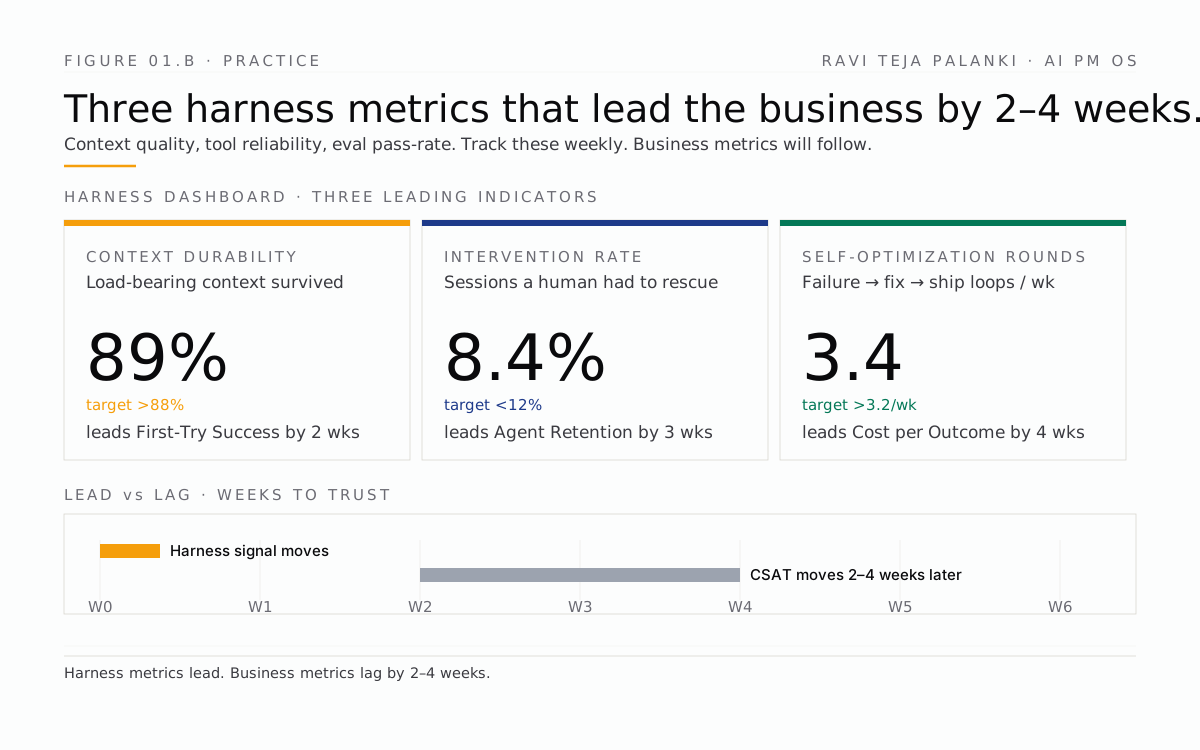
| Metric | What it actually measures | Target | Predicts (2–4 wks out) |
|---|---|---|---|
| Context Durability | Did the right context survive to the decision moment? | >88% | First-Try Success Rate |
| Intervention Rate | How often a human had to rescue the agent | <12% | Agent Retention + Escalation Rate |
| Self-Optimization Rounds | How many "find bug → ship fix" loops finished this week | >3.2 / wk | Cost per Outcome + compounding moat |
These aren't engineering metrics. They're product metrics — the vital signs of the actual user experience.
Context Durability — Did the right context survive to the moment it was needed?
In one sentence. Context Durability is the percentage of agent decisions where the specific piece of information the agent needed to act correctly was still inside its working memory at the moment of decision — the same skill as a waiter who still remembers your no-onion request by the time the food reaches the table.
Between turns, context gets compacted, summarized, and overwritten by tool calls. The metric counts how often the load-bearing piece survived.
Picture this. An invoice-extraction agent loads vendor terms at turn 1: "Net-30, 2% early-pay." By turn 7 it needs those terms to validate a discount. If the exact terms survived → durable, right answer. If they got summarized into "standard terms" → broken context, wrong answer, wasted run.
- Target: >88%
- Proof point: A team at AI Dev 25 NYC moved theirs from 71% → 91% by redesigning the orchestration layer. First-Try Success Rate followed: 62% → 84% over four weeks.
- Lift math: A 10-point lift delivers 15–25% lift in First-Try Success Rate and 20–35% reduction in cost per outcome — with a 2–4 week lag.
Intervention Rate — How often did a human have to step in?
In one sentence. Intervention Rate is the percentage of agent sessions where a human had to step in to fix, restart, or substantially rewrite the agent's output — the same way a manager has to redo a new hire's work before it's ready for the customer.
The count includes every session where the user restarted from scratch, rewrote more than half the output, or asked the agent to retry. Divide by total sessions. That number is your Intervention Rate.
Picture this. A sales-rep email drafter runs 100 sessions in a week. In 18 of them, the rep deletes the draft and starts over. Intervention Rate = 18%. The reps are telling you, with their hands, that the agent can't be trusted to finish.
- Target: <12%
- Real-world band: Above 15%, agents don't get used twice. Below 5%, people seek them out unprompted.
- Lift math: The single most predictive metric for autonomous-outcome retention. A 30-day cohort above 15% churns. The same cohort below 5% expands.
Self-Optimization Rounds — How many full learning loops finished this week?
In one sentence. Self-Optimization Rounds is the number of complete improvement loops the team finishes per week — find a real failure, build a test for it, change the agent's setup, prove the fix works, ship — the same cadence as a restaurant that spots a failing dish on Monday and serves the redesigned version by Friday.
One round = one completed cycle: production failure → eval dataset → harness change → validate → ship. Started-but-not-shipped doesn't count.
Picture this. Monday: trace a failed run. Tuesday: build 12 eval cases for that failure mode. Wednesday: tweak the system prompt and add a tool retry. Thursday: validate, see a 6% lift on the eval set. Friday: deploy. That's one round in five days.
- Target: >3.2 / week
- Real-world band: Below 1/week, the system decays. Above 3.2, it compounds faster than any frozen vendor product.
- Lift math: Cost per outcome drops every round. The compounding is the moat — and the moat is what your CFO is actually buying when they fund the AI program.
If your harness metrics are red, no amount of marketing or sales effort will create sustainable agentic growth. Fix the harness first.
Where this hits in production
The Apple Project Campos lesson. Apple's Project Campos — the architecture behind Apple Intelligence — embeds Stateless AI plus Private Cloud Compute (PCC). They built the harness before committing to a frontier model partnership, and the harness is what lets them swap underlying models (Gemini → in-house Ferret-3) without rewriting the product. The harness is the moat; the model is the supplier.
The David's Bridal MCP example. A retailer's AI assistant was rebuilt around MCP (Model Context Protocol) tool access — not as a feature add, but as a harness redesign. Within 8 weeks, the team's Self-Optimization Rounds went from <1/week to 4–5/week because each tool integration produced its own eval signal. That's the operating model that turns a chatbot into a product.
The Cursor counterexample. Cursor shipped a beautifully crafted IDE agent. The harness was thin — most of the magic was in the prompt. When power users started running multi-hour agentic sessions, the inference bill blew through the per-seat margin assumption. The fix wasn't pricing. It was re-architecting the harness — context compression, semantic caching, loop pruning — to drive cost per outcome down at the same quality level. That's the work the SaaS playbook treats as engineering plumbing. In AI PM, it's the work that determines whether the business model works at all.
Connecting the dots
This series sits on top of the engineering deep dives. The relationship is structural:
- Harness Engineering series — teaches you how to build the harness: 8 chapters on the runtime layer, error recovery, memory model, and the patterns that turn raw models into long-running agents.
- Agentic Stack series — teaches you the agent architecture: 35 chapters on CONTEXT (the 7-layer framework), tool design, multi-agent orchestration, and the production patterns that work.
- AI Evals series — teaches you how to measure the harness: 35 chapters on rubrics, judges, flywheels, deployment governance, and the eval discipline that turns hope into evidence.
If you're a PM who hasn't read those, your harness conversations with engineering will be shallow. Read at least the L1 of each before going deeper into AI PM OS — the cross-references in the chapters that follow assume you've absorbed the engineering vocabulary.
This series — AI PM OS — teaches the monetization, GTM, and strategic layer that turns harness capability into PMF, profitable revenue, and defensible moats. Engineering builds it. AI PM OS ships it. Together: the complete operator. Build it right + sell it right. Idea → real-world → profitable.
Three threads run through the rest of the series:
- The Pricing Thread (L1-T07 → L1-T08 → L1-T09 → L2-T04 → L2-T05 → L2-T09 → L3-T07): Why per-seat pricing dies, the Inference Treadmill, the Golden Quadrant, outcome-based pricing.
- The Eval Thread (L1-T05 → L2-T06 → L2-T07 → L3-T06 → L3-T10): Taste at Speed, evals as the new PRD, stakeholder translation, the self-improving moat.
- The Harness Thread (L1-T01 → L2-T03 → L3-T01 → L3-T02 → L3-T03 → L3-T05 → L3-T08): This chapter, then how harness shows up in product architecture, what to own as a PM, compounding feedback loops, multi-model orchestration, GTM-AI Fit, and vendor strategy.
Plus a Strategic Clarity thread (L1-T02 → L1-T04 → L1-T10 → L3-T07 → L3-T08 → L3-T09 → L3-T10) and a Taste at Speed thread (L1-T05 → L2-T06 → L3-T06) that thread through the levels.
The trap
The trap is treating the harness as engineering's problem and waiting for them to "deliver." That framing kills AI products.
Harness work is PM work because the harness is the integration layer between intent and execution. PMs define WHAT (intent, user context, domain rules, success criteria). Engineers build HOW (retrieval infrastructure, inference pipeline, observability stack). When PMs skip the WHAT, teams ship technically impressive systems that feel unintelligent because nobody specified what mattered. When engineers skip the HOW, the product runs on hope. The harness is the integration layer where both jobs meet — and the PM owns the integration.
The second trap is waiting for the next model to fix the harness problem. Harness debt compounds faster than technical debt. Weak harnesses create fragile agents that require constant babysitting — destroying the autonomous outcome value prop and stalling PMF, regardless of model improvements. The teams that invested in mature harnesses in 2024–2025 are the ones now achieving GTM-AI Fit on Agentic.Market while their competitors are stuck patching brittle integrations.
The third trap is the CFO conversation. Your CFO doesn't care about Context Durability. They care about cost per acquisition, gross margin, and unit economics. Your job — the Bridger move — is to translate:
"Last week we lifted Context Durability on our top workflow from 76% to 89%. That predicts a 17% lift in First-Try Success Rate by month-end. At current volume, that's $42K/month in reduced support intervention cost and an estimated 11-point lift in 30-day agent retention."
The harness metric → business metric translation is the muscle that earns harness work the budget it needs. Without it, harness investment looks like cost. With it, harness investment looks like the moat-building work it actually is.
Remember this
- AI PM ≠ SaaS PM. Three SaaS assumptions break in AI: marginal cost ≈ zero, deterministic output, human-only users. When the assumptions break, the playbooks break.
- The center of gravity has moved from the product to the harness. The model is the commodity. The harness — orchestration + memory + skills + context + evals — is the moat.
- Three harness metrics predict business outcomes 2–4 weeks ahead: Context Durability (>88%), Intervention Rate (<12%), Self-Optimization Rounds (>3.2/week). If they're red, no GTM motion will save the product.
- The litmus question: "If we froze the model tomorrow and could only improve the harness, how much PMF lift could we unlock?" Top teams answer with a number, a plan, and three named experiments.
- Harness work is PM work, not engineering plumbing. The PM owns the integration layer where intent meets execution. Skip it and the product runs on hope.
In practice
Step 1: Map your stack to the four-layer model. Write down your top 5 production AI workflows. For each, name what lives in each layer (Model, Harness, Tools, Environment). If you can't fill in the Harness column, that's the workstream. The harness is what you own, and what becomes your moat.
Step 2: Track the three harness metrics that predict business outcomes. Context Durability, Intervention Rate, Self-Optimization Rounds. Set Week-4 targets. Tie each to a downstream business metric (First-Try Success Rate, Agent Retention, Cost per Outcome). Put the dashboard on the team's wall.
Step 3: Run the first hill-climbing iteration. Pick the workflow with the worst Context Durability. Mine traces for the top 3 failure modes. Build evals for each. Make one targeted harness change (compaction strategy, filesystem offloading, Ralph Loop pattern, retrieval rerank). Validate against a holdout set. Document what changed and what improved. That's one Self-Optimization Round. Aim for 3+ per week within 30 days.
Step 4: Connect every harness change to a business metric in your leadership update. No CFO cares about Context Durability. Translate every harness lift into a forecast of First-Try Success Rate, support cost reduction, and 30-day agent retention. Show the lag (2–4 weeks). Show the compounding effect (each Self-Optimization Round tightens the moat).
Step 5: Audit your team's operating model. Run the litmus question. If the team shrugs, the harness conversation hasn't been had. Schedule it as a recurring review — weekly for new products, monthly for mature ones. The harness review is the AI PM equivalent of the SaaS PM's funnel review. It's the meeting where the work that compounds gets visible.
The practice — visualized
- What decision does owning the harness change for your team?
- What evidence would show the harness, not the model, explains your results?
- What does harness mastery still not prove about cost or trust?
References
- Cursor — Pricing & Billing Update (usage-based reality)
- Replit Q2 2025 Coverage — Margin Compression
- Apple — Private Cloud Compute
- Anthropic — Demystifying Evals for AI Agents
- Anthropic — Harness Design for Long-Running Apps
- Andrej Karpathy — Software 3.0 / Autoresearch Loop
- Model Context Protocol (MCP) Specification